Introduction & Market Overview
The global coffee industry is undergoing a seismic shift driven by changing consumer preferences, modern fast-paced lifestyles, and the unstoppable rise of specialty coffee. While traditional coffee brewing methods—such as pour-over, espresso machines, and French presses—offer exceptional quality, they often require dedicated equipment, time, and cleanup. On the other end of the spectrum, instant coffee offers convenience but frequently compromises on flavor profile and aroma.
Enter the hanging ear coffee bag (commonly referred to as a drip coffee bag). Originating in Japan in the 1990s, this single-serve, portable pour-over format has expanded rapidly across Asia, Europe, and the Americas. By 2026, the global drip bag coffee market has reached multi-billion-dollar valuations, growing at a CAGR of over 7%.
For coffee roasters, packaging distributors, private label brands, and hospitality chains, understanding why the hanging ear coffee bag is capturing market share worldwide is essential. This detailed buyer guide provides an expert breakdown of product architecture, material selection, applications, strategic benefits, customization possibilities, production logistics, and regulatory compliance.
1. Product Overview
A hanging ear coffee bag is an all-in-one, single-use brewing solution designed to deliver a fresh pour-over coffee experience without specialized hardware. The user simply tears open the top seal, stretches the paper wings (the “hanging ears”) over the rim of a mug, and pours hot water over the ground coffee.
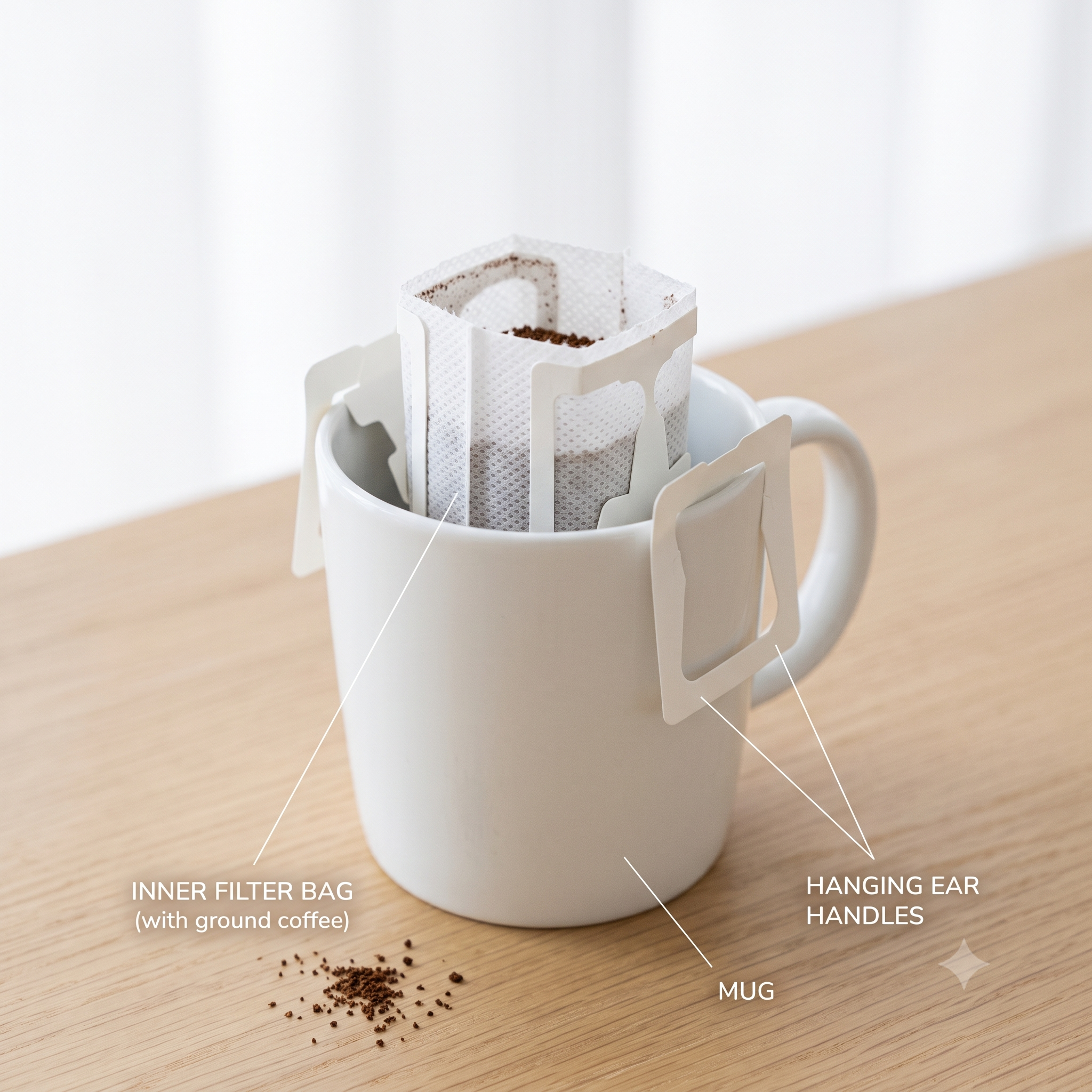
Key Components of a Hanging Ear Coffee Bag System:
-
Inner Filter Bag: A micro-porous food-grade filter pouch containing 8g to 12g of precisely ground specialty coffee (medium-fine grind).
-
Hanging Ear Handles: Structural paper or laminated arms attached to both sides of the filter bag. These arms hook securely onto cups of varying diameters.
-
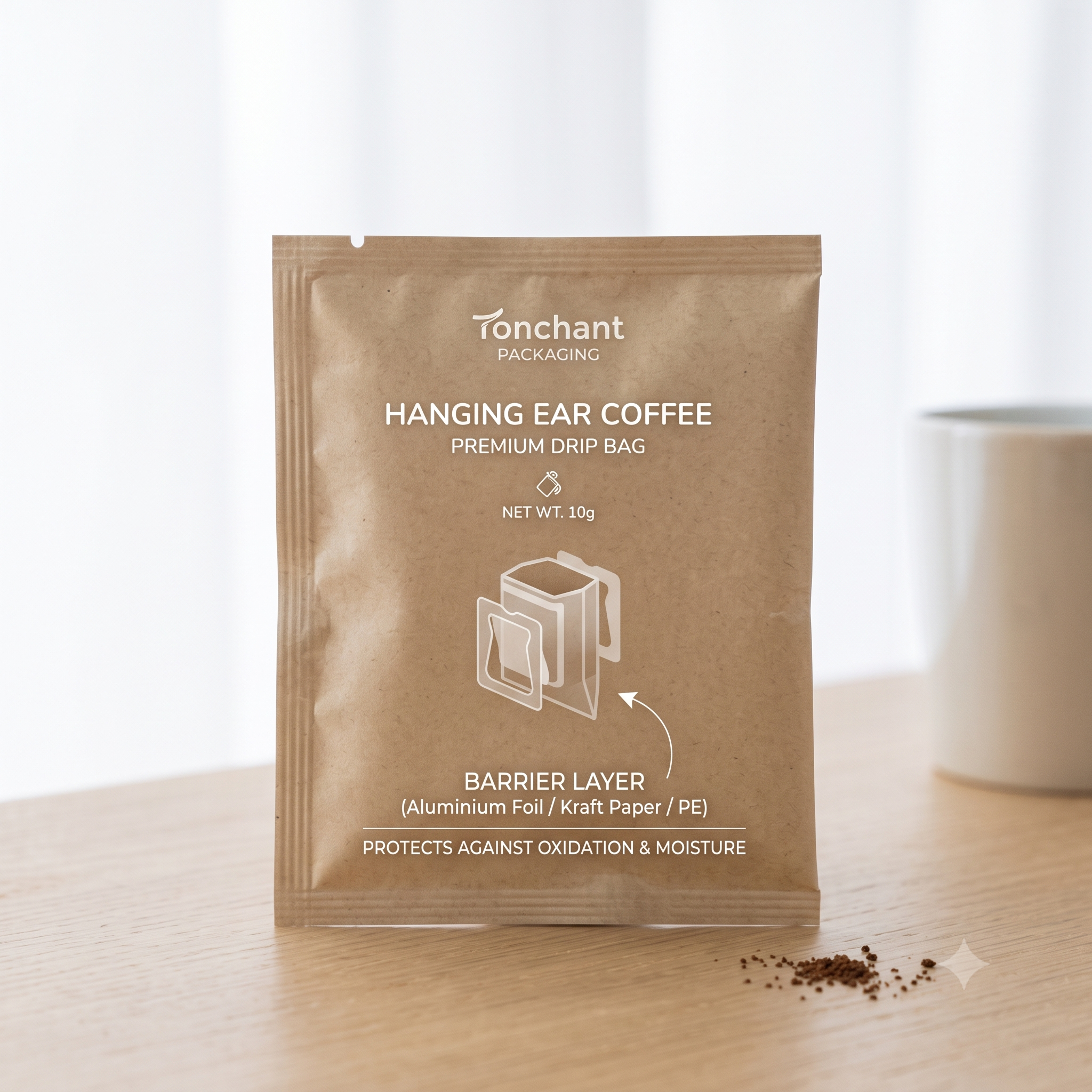
Outer Barrier Pouch: A high-barrier foil or mono-material sachet sealed under nitrogen flushing ($N_2$) to prevent oxidation and extend shelf life up to 12–18 months.
2. Material Specifications & Technology
Selecting the right materials for both the inner filter and outer pouch determines flavor extraction, structural integrity, and shelf-life preservation.
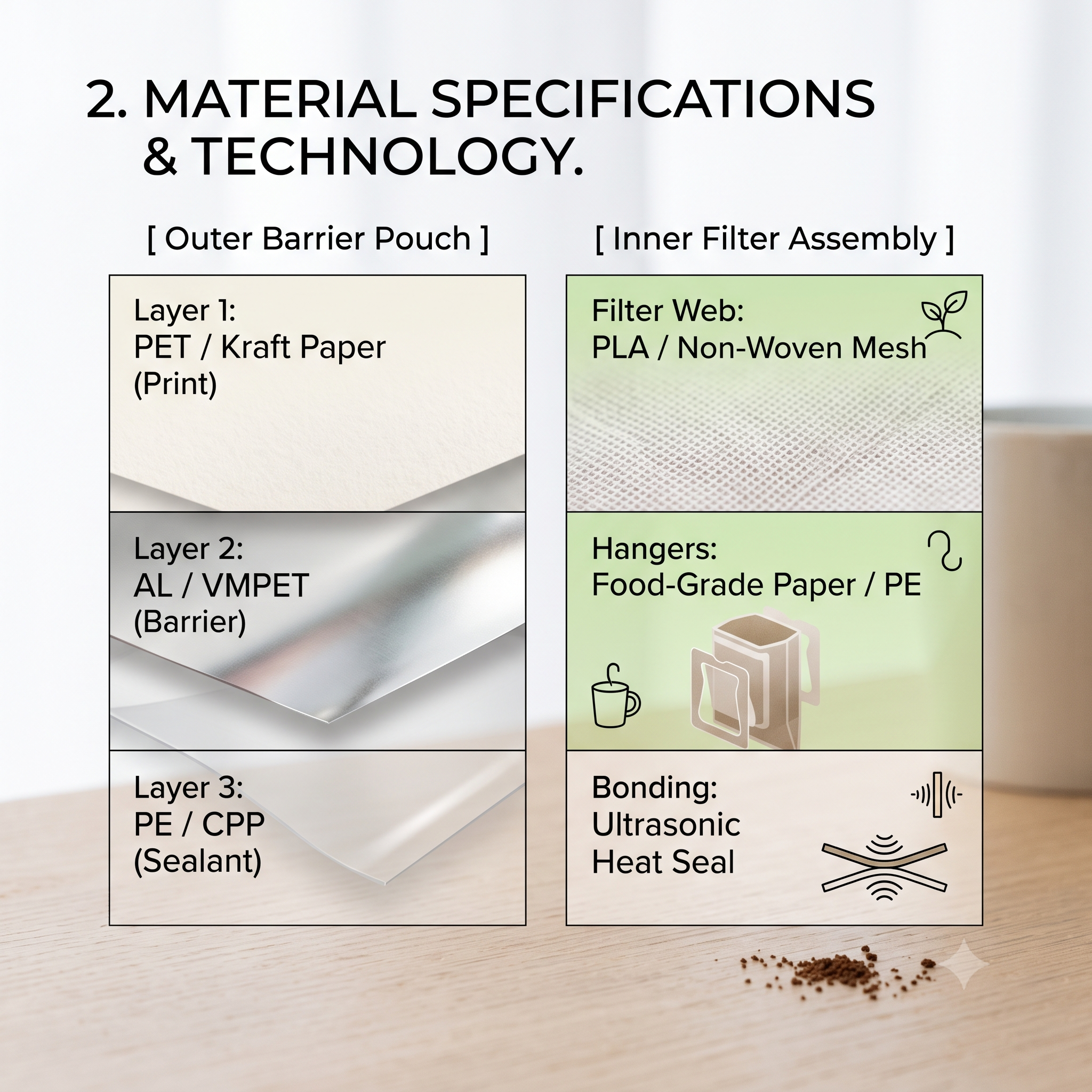
A. Inner Filter Bag Materials
-
Non-Woven Polypropylene (PP/PET):
-
Characteristics: Traditional material offering high tensile strength, uniform water flow rate, and heat resistance.
-
Pros: Cost-effective, excellent flow control, non-reactive.
-
Cons: Non-biodegradable (petroleum-based).
-
-
Polylactic Acid (PLA) / Cornstarch Fiber:
-
Characteristics: Plant-derived, 100% bio-based material.
-
Pros: Fully industrially compostable, eco-friendly marketing appeal, excellent filtration clarity.
-
Cons: Higher raw material cost compared to standard PP.
-
-
Japanese Woven PET Mesh:
-
Characteristics: Ultra-fine woven grid offering maximum water flow control and high visual transparency during brewing.
-
Pros: Premium aesthetic, leaves virtually zero sediment.
-
B. Hanging Ear Paper Arms
-
Poly-Coated Food Board: Engineered for high rigidity and hot-water resistance. Prevents the hanger from softening or collapsing into the cup during water pouring.
-
Ultrasonic Bonding: The hanging ears are attached to the filter bag using ultrasonic welding technology rather than chemical glues, ensuring no chemical odor or contamination affects the coffee taste.
C. Outer Barrier Sachet Layer Structures
| Structure Type | Layer Construction | Primary Benefit |
|---|---|---|
| Standard High-Barrier | PET / VMPET / PE | Excellent cost-to-barrier ratio; blocks 99% light & oxygen. |
| Ultra-Premium Foil | Kraft Paper / AL / PE | Maximum barrier (zero OTR/WVTR); organic, tactile feel. |
| Recyclable Mono-Material | MDO-PE / PE | Fully recyclable (Store Drop-off / Stream 4 compliant). |
| Compostable Barrier | Kraft / NK / PLA | 100% industrial compostable packaging solution. |
3. Applications Across Key Industries
The versatile nature of the hanging ear coffee bag makes it attractive to diverse B2B sales channels:
1. Specialty Coffee Roasters
-
Sample Distribution: Allows roasters to send single-origin microlot samples to prospective B2B clients or subscription members without risking bean oxidation.
-
Product Line Extension: Expands retail shelves beyond 250g/1kg bean bags into single-serve retail boxes.
2. Hospitality, Airlines, and Cruise Lines
-
In-Room Dining & Hotel Suites: Replaces substandard instant coffee and bulky, hard-to-clean pod machines in luxury hotel rooms.
-
In-Flight Services: Premium airlines use hanging ear drip bags to serve authentic fresh brewed coffee at 30,000 feet without specialized brewing hardware.
3. Corporate & Event Gifting
-
Custom-printed outer pouches serve as branded merchandise for corporate giveaways, weddings, tech conferences, and holiday gift baskets.
4. Outdoor, Camping, and E-Commerce Subscriptions
-
Lightweight, compact individual sachets fit easily into backpack pockets, travel kits, or lightweight mailer boxes, making them ideal for direct-to-consumer (D2C) subscription models.
4. Key Advantages of Hanging Ear Coffee Bags
Why Consumers Love Them:
-
No Equipment Required: Only hot water and a mug are needed—no grinder, kettle gooseneck, or dripper required.
-
Authentic Pour-Over Taste: Unlike instant coffee, hanging ear bags contain real freshly ground coffee beans, enabling true immersion and percolation extraction.
-
Portability: Pocket-sized individual pouches allow consumers to enjoy specialty coffee anywhere (office, mountains, hotel rooms).
-
Zero Mess: Used filter bags are pulled off the rim and discarded immediately after brewing.
Why Brands and Retailers Love Them:
-
Higher Profit Margins: Single-serve packaging yields higher margins per gram of coffee compared to bulk whole bean sales.
-
Extended Shelf Life: Nitrogen-flushed packaging ($N_2 < 1\%\text{ O}_2$) preserves volatile aromatic compounds for up to 18 months.
-
Lower Carbon Footprint than Capsules: Hanging ear bags require significantly less plastic and aluminum than rigid single-serve coffee pods, reducing shipping weight and volume.
5. Customization Options for B2B Buyers
To stand out in retail and D2C spaces, custom packaging configurations are vital. Manufacturers offer custom options across the entire packaging assembly:
A. Inner Bag Customization
-
Filter Dimensions: Standard ($70\text{mm} \times 90\text{mm}$ holding 8–12g) or Large ($90\text{mm} \times 100\text{mm}$ holding up to 15g).
-
Hanger Printing: Logos or brand icons printed directly onto the hanging ear handles using food-compliant water-based inks.
B. Outer Sachet Finishing
-
Printing Technology: * Rotogravure Printing: Up to 10 colors; ideal for high-volume runs ($>50,000$ units).
-
HP Indigo Digital Printing: Zero plate costs; ideal for short runs, multiple SKU variations, and seasonal releases.
-
-
Finishes: Matte soft-touch, glossy, spot UV, metallic foil stamping, or raw tactile Kraft paper.
C. Retail Outer Box Configurations
-
5-Pack / 10-Pack Retail Boxes: Color-printed folding cartons (FSC-certified board).
-
Display Counter Boxes: Tear-away dispenser boxes designed for retail counters or hotel coffee stations.
6. MOQ (Minimum Order Quantity) & Production Lead Times
Understanding production minimums and turnaround times helps brands plan inventory and capital allocation.
Standard B2B Supply Configurations
| Service Level | Description | Typical MOQ | Lead Time |
|---|---|---|---|
| Blank Stock Filters | Unprinted inner filters + generic outer pouches for self-packing | 5,000 pcs | 3–5 Business Days |
| Digital Printed Outer Pouches | Fully custom-printed sachet pouches via digital press | 5,000 – 10,000 pcs | 2–3 Weeks |
| Rotogravure Custom Pouches | Mass production with lowest unit cost | 50,000+ pcs | 3–4 Weeks |
| OEM Full Co-Packing (Beans + Packaging) | Complete turnkey contract filling with nitrogen flushing | 10,000 units | 3–5 Weeks |
7. Quality Control, Compliance & Certificates
Because the inner filter comes into direct contact with near-boiling water ($90^\circ\text{C}-96^\circ\text{C}$), adherence to strict food safety standards is mandatory.
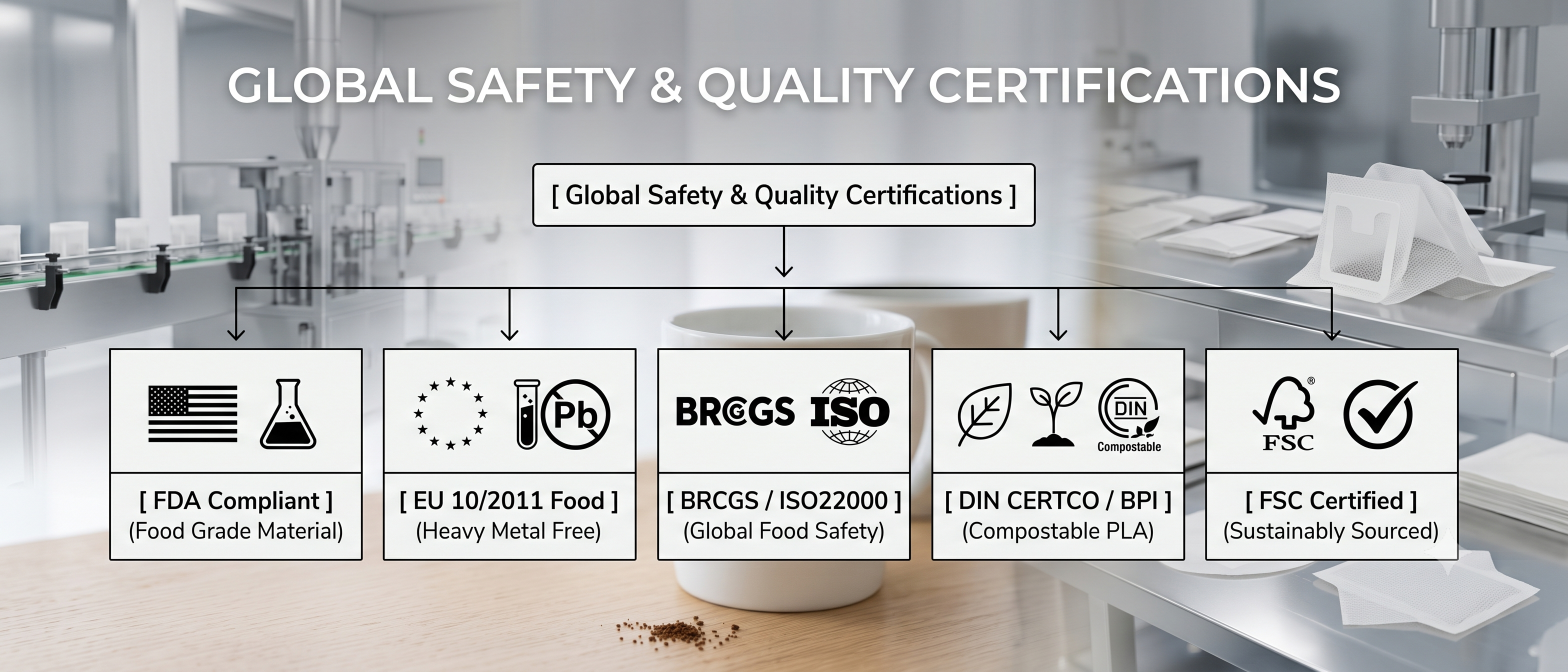
Essential Certifications to Request from Your Supplier:
-
Food Contact Safety:
-
FDA 21 CFR 177: Compliance for food-contact polymers in the United States.
-
EU Regulation No. 10/2011: European Union standard for plastic materials intended to come into contact with food.
-
LFGB (Germany): High-standard food safety compliance for European distribution.
-
-
Factory & Quality Management:
-
BRCGS (British Retail Consortium Global Standards): Grade A/AA certification for packaging materials.
-
ISO 22000 / ISO 9001: Food safety management systems and quality control workflows.
-
-
Environmental & Compostability Standards:
-
DIN CERTCO / EN 13432: European standard for industrial compostability (crucial for PLA filters).
-
BPI Certification: Biodegradable Products Institute verification for North America.
-
FSC (Forest Stewardship Council): Ensures outer paper boxes originate from responsibly managed forests.
-
8. Comparative Analysis: Drip Bags vs. Alternative Single-Serve Formats
To help packaging buyers evaluate market options, the table below compares the hanging ear coffee bag against K-Cups/Nespresso Capsules, Instant Freeze-Dried Coffee, and Traditional Pour-Over:
| Feature / Metric | Hanging Ear Coffee Bag | Single-Serve Capsules (K-Cup / Nespresso) | Freeze-Dried Instant Coffee | Traditional Pour-Over (V60/Chemex) |
|---|---|---|---|---|
| Brewing Hardware Required | None (Only Mug & Hot Water) | Dedicated Machine Required | None | Kettle, Scale, Dripper, Filter |
| Coffee Quality / Taste | High (Fresh Ground Specialty) | Medium | Low to Medium | Ultra High |
| Capital Investment for User | $0 | $100 – $300 (Machine Cost) | $0 | $50 – $150 |
| Packaging Waste Footprint | Low (Flexible Film + Mesh) | High (Rigid Plastic/Aluminum Cup) | Low (Glass Jar or Foil Strip) | Low (Paper Filter) |
| Compostable Options | Available (PLA Fibers) | Limited / Hard to Separate | N/A | Fully Compostable |
| Storage & Shipping Volume | Flat, Lightweight, Compact | Bulky, Heavy Volume | Medium Volume | N/A (Beans only) |
| Shelf Life (Nitrogen Flushed) | 12 – 18 Months | 12 – 24 Months | 24+ Months | 1 – 3 Months (Fresh Beans) |
9. Frequently Asked Questions (FAQ)
Q1: How much ground coffee can a standard hanging ear coffee bag hold?
Answer: Standard inner drip filter bags ($70\text{mm} \times 90\text{mm}$) typically hold between 8 grams and 12 grams of ground coffee. Extra-large filters ($90\text{mm} \times 100\text{mm}$) can hold up to 15 grams for consumers who prefer stronger extractions or larger mug sizes ($250\text{ml}-300\text{ml}$).
Q2: What grind size should be used for hanging ear drip coffee bags?
Answer: A medium-fine grind (similar to standard V60 pour-over or auto-drip machines) is recommended. If the grind is too fine, water will overflow the filter; if too coarse, the extraction will be weak and sour.
Q3: How do you prevent coffee in hanging ear bags from going stale?
Answer: Freshness is maintained through Nitrogen ($N_2$) Flushing during the automated pouch packaging process. By displacing oxygen inside the outer sachet to under $1\%$, residual oxidation is halted, preserving volatile coffee aromatics for 12 to 18 months.
Q4: Are hanging ear coffee bags eco-friendly?
Answer: Yes, especially when compared to plastic capsule systems. Brands can choose 100% PLA (cornstarch-based) bio-degradable filter fabrics combined with industrially compostable outer film structures or recyclable mono-material PE films.
Q5: Can I pack hanging ear coffee bags on automated packaging machines?
Answer: Yes. Automatic Drip Coffee Bag Packaging Machines perform filter cutting, hanging ear attachment, coffee dosing, ultrasonic sealing, nitrogen flushing, and outer pouch sealing in a single continuous process, producing up to 40–60 sachets per minute per lane.
10. Conclusion & Strategic Buying Recommendations
The global surge in demand for hanging ear coffee bags is not a passing trend; it represents a permanent evolution in single-serve coffee consumption. By combining the uncompromised taste profile of fresh pour-over coffee with zero-equipment convenience, hanging ear bags bridge the gap between instant convenience and specialty coffee craft.
Summary Checklist for B2B Buyers:
-
Identify Your Market Positioning: Choose PLA bio-mesh for eco-focused demographics, or standard PP non-woven for maximum cost efficiency.
-
Verify Barrier Integrity: Ensure your outer sachet structure includes high barrier layers (AL, VMPET, or high-barrier PE) and utilizes nitrogen flushing to guarantee shelf life.
-
Audit Supplier Certifications: Demand test reports (FDA, EU 10/2011, BRCGS) to verify material safety under high water temperatures.
-
Leverage Customization: Utilize digital printing for short-run seasonal microlots, and transition to rotogravure printing as volume scales.
By partnering with an experienced, certified flexible packaging manufacturer, roasters and distributors can capitalize on this rapidly growing market and deliver premium coffee experiences to consumers worldwide.
Post time: Jul-12-2026


