In the competitive landscape of the global coffee industry, every variable in the brewing process matters. For roasters, equipment manufacturers, and packaging distributors, supplying a premium bean is only half the equation. The medium through which that coffee is brewed—the filter—can either elevate the cup or ruin it entirely.
Understanding the nuances of food grade coffee filter paper is essential for B2B buyers looking to source reliable, safe, and high-performing products. At Tonchant, our deep integration with the coffee supply chain—from collaborating with equipment factories like Semari Coffee Factory to supplying roasteries across Southeast Asia and beyond—has given us profound insights into what truly makes a filter exceptional.
This comprehensive guide breaks down the critical elements of high-quality coffee filter paper, providing you with the knowledge to make informed purchasing and manufacturing decisions.
1. Product Overview
At its core, food grade coffee filter paper is a highly specialized, semi-permeable barrier. Its primary function is to trap insoluble coffee grounds and heavy lipid oils (cafestol and kahweol) while allowing the soluble flavor compounds and water to pass through freely.
Low-quality filters often suffer from inconsistent pore sizes, chemical residues, or poor structural integrity, leading to stalled brews, burst seams, and a distinct “papery” taste in the cup. High-quality filter paper, on the other hand, is engineered for neutrality, strength, and precision. It acts as an invisible facilitator, ensuring the end consumer tastes the coffee’s origin, not the manufacturing process.
2. Materials: The Foundation of Quality
The superiority of a coffee filter begins with its raw materials. Premium filters are never made from standard paper stock; they are woven from specific botanical fibers.
Virgin Wood Pulp
High-quality filters utilize virgin wood pulp rather than recycled paper. Recycled materials, while generally eco-friendly, cannot be guaranteed as food-safe due to unknown prior uses and potential chemical contaminants. Virgin pulp ensures absolute purity and compliance with international food contact regulations.
Abaca (Manila Hemp) Fibers
The true hallmark of top-tier coffee filter paper is the inclusion of Abaca fibers. Sourced primarily from the Philippines and Indonesia, Abaca is a species of banana native to the region.
-
Porosity: Abaca fibers are incredibly fine and uniform, allowing manufacturers to create paper with highly precise micropores.
-
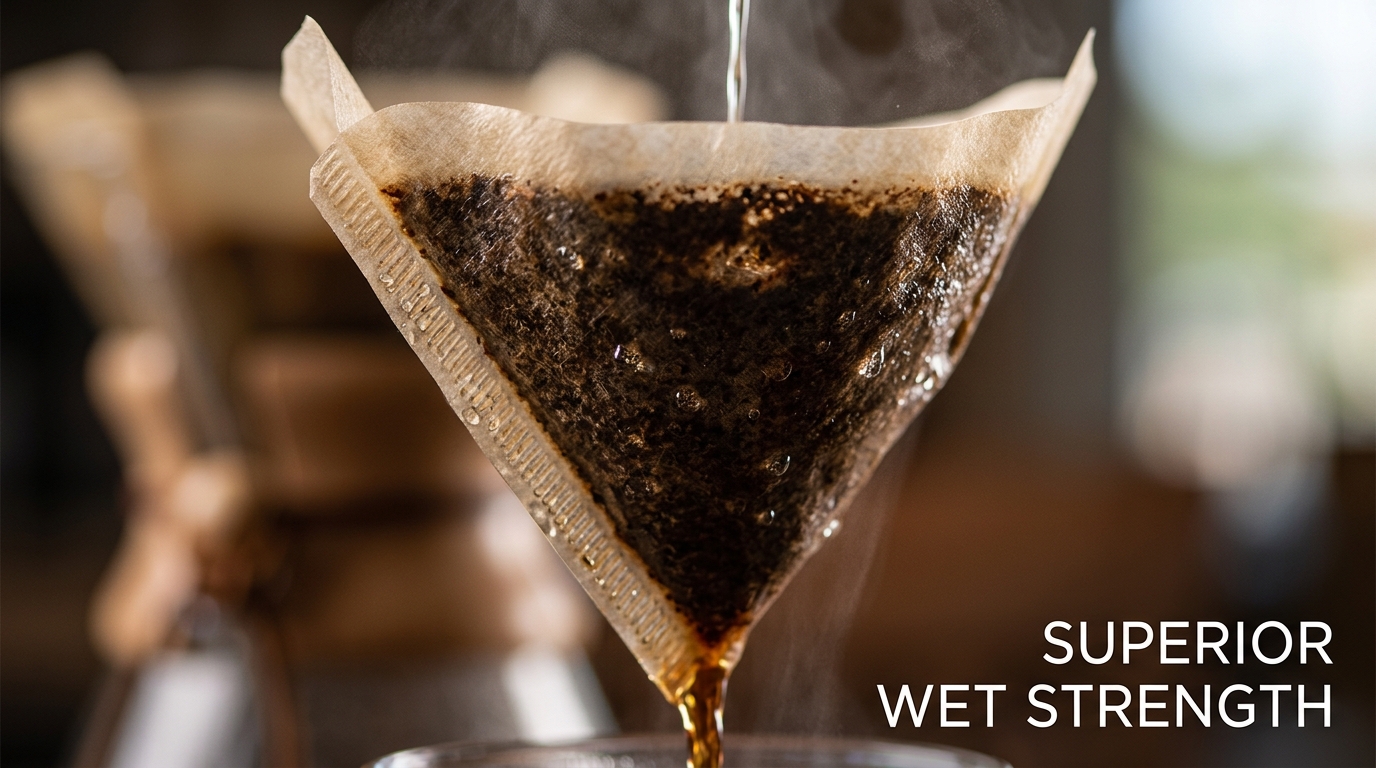
Wet Strength: Abaca has unmatched tensile strength when saturated. This prevents the filter from collapsing or tearing under the weight of hot water and expanding coffee grounds.
Eco-Friendly and Biodegradable Commitments
Modern high-quality materials must align with global sustainability goals. Premium filters are 100% biodegradable and compostable. Furthermore, they are processed using Totally Chlorine-Free (TCF) oxygen bleaching or left as natural, unbleached brown paper, ensuring zero toxic runoff during production.
3. Applications
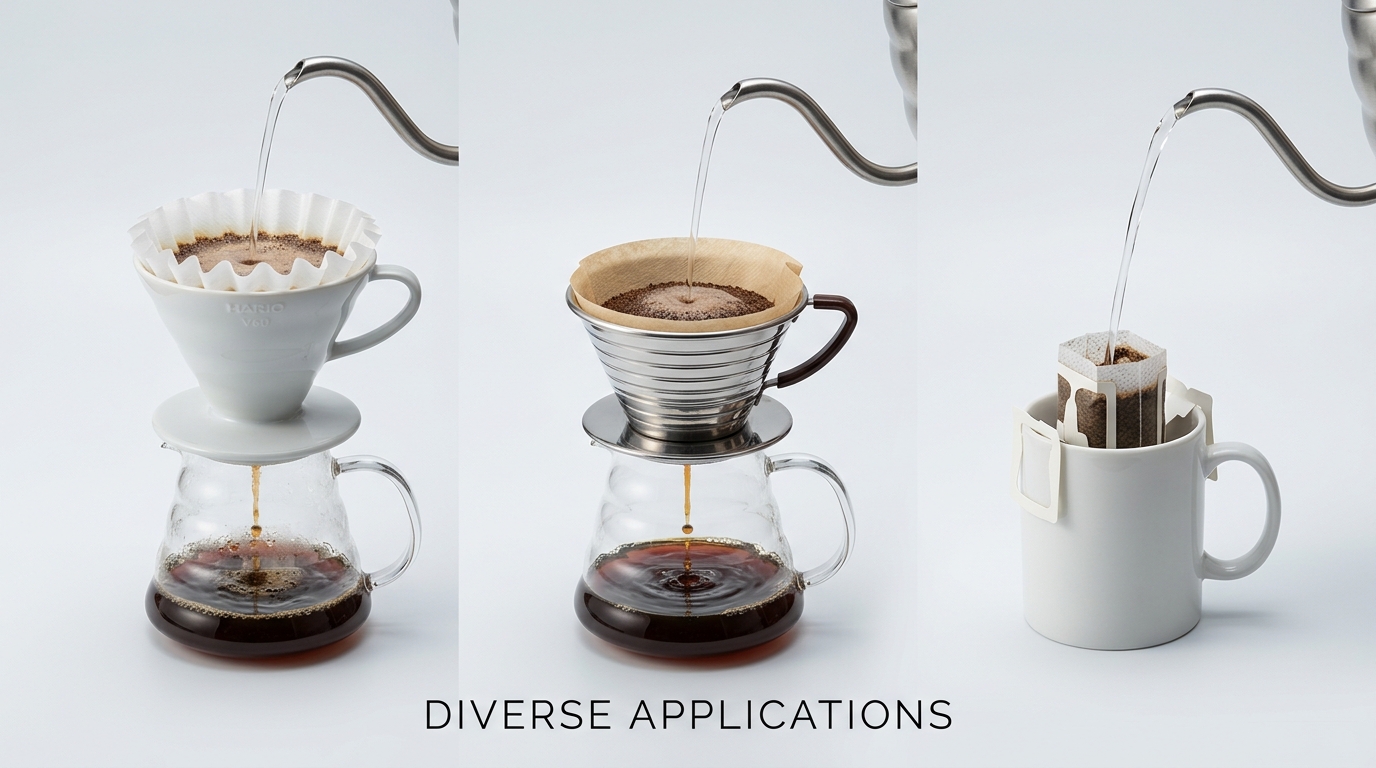
Different brewing methods require specific paper thicknesses, flow rates, and shapes. High-quality manufacturing caters to all these specialized applications:
-
Specialty Pour-Over (V60, Chemex, Kalita Wave): Requires paper with high flow rates and absolute flavor neutrality to highlight the delicate acidity and floral notes of light roasts.
-
UFO Drip Filter Bags: A rapidly growing segment in portable specialty coffee. These require a delicate balance: the paper must be strong enough to hang securely on a cup via ultrasonic-welded “ears” but porous enough to allow a relatively quick drawdown for consumers on the go.
-
Commercial Batch Brewers: High-volume diners and cafes require large flat-bottom or basket filters that prioritize extreme wet strength to hold massive amounts of grounds without collapsing during a high-temperature, multi-liter brew cycle.
-
Espresso Machine Filtration: Small, circular paper filters placed over espresso pucks (often called “puck screens” or bottom filters) to increase extraction evenness and keep espresso machine shower screens clean.
4. Advantages of Sourcing High-Quality Paper
Investing in premium food grade coffee filter paper offers distinct competitive advantages for your brand and your clients:
- 1
Flavor Clarity: Premium TCF (Totally Chlorine-Free) paper imparts zero papery or woody taste, ensuring the roaster’s intended flavor profile is delivered perfectly.
- 2
Predictable Flow Rates: Consistent fiber distribution means the water draws down at a predictable speed every time. This consistency is crucial for baristas dialing in their daily recipes.
- 3
Unbreakable Seams: Cheap filters use glue. High-quality filters use mechanical crimping or ultrasonic welding to create seams that will never burst under pressure.
- 4
Brand Trust: Supplying certified, safe, and high-performing filters protects your brand from negative consumer feedback related to failed brews or off-tastes.
5. Customization and Outer Packaging Integration
For B2B buyers, the filter paper is often part of a broader packaging strategy. We offer extensive customization to fit your specific product lines.
-
Filter Customization: We can manufacture custom die-cut shapes, specialized sizes, and apply bespoke edge crimping patterns. OEM branding can also be applied to outer retail boxes.
-
Cohesive Packaging Solutions: When sourcing UFO drip bags or standard filters, the outer protective packaging is just as critical. We specialize in engineering the perfect barrier films. For instance, if you are packing roasted beans or delicate drip bags, we guide clients through the selection of high-barrier, recyclable materials.
-
Understanding the difference between EVOH+PE (excellent oxygen barrier, great for preserving the aroma of freshly ground coffee in drip bags) and MDOPE+PE (high stiffness, fully recyclable mono-material structure) allows us to tailor the outer pouch perfectly.
-
Whether you need 250g stand-up pouches for retail shelves or 12 oz side-gusset bags for wholesale distribution, aligning your filter sourcing with your flexible packaging ensures a streamlined, eco-friendly supply chain.
-
6. MOQ (Minimum Order Quantity)
We structure our MOQs to accommodate both boutique roasters and massive international distributors:
-
Standard Off-the-Shelf Filters: For standard V60 cones, basket filters, or blank UFO drip bags, MOQs are highly accessible, often starting at 10,000 to 50,000 pieces.
-
Custom OEM Projects: For custom shapes, bespoke printed retail boxes, or fully customized outer flexible packaging (like printed EVOH+PE film rolls for automated drip bag packaging machines), MOQs typically range from 100,000 to 300,000 pieces to account for printing plates and die-cut tooling setups.
7. Lead Time and Logistics
Managing international logistics efficiently is a cornerstone of our B2B operations.
-
Production: Standard unprinted orders generally ship within 10–15 days. Custom OEM orders require 20–30 days following digital proof approval.
-
Global Shipping: Filter paper is a high-volume, low-weight commodity. To optimize ocean freight rates, we strongly advise clients to consolidate orders into 40HQ containers. Maximizing the cubic volume of a 40HQ drastically reduces the landed cost per unit compared to LCL (Less than Container Load) shipments. Our export team expertly manages customs documentation for seamless entry into major markets, from the US and EU to Southeast Asian hubs like Jakarta and Bali.
8. Certificates and Compliance
High-quality filter paper must be backed by rigorous, globally recognized certifications. Never compromise on compliance when sourcing food grade coffee filter paper.
-
FDA (US) / LFGB (Europe): Mandates that the material is entirely safe for direct contact with food and boiling water, guaranteeing no migration of harmful substances.
-
FSC (Forest Stewardship Council): Certifies that the virgin wood pulp is sourced from responsibly managed forests that provide environmental, social, and economic benefits.
-
Compostability Standards (EN 13432 / OK Compost): Ensures the filters will safely and completely biodegrade in commercial composting facilities, aligning with circular economy initiatives.
-
ISO 9001/14001: Reflects a manufacturer’s commitment to consistent quality management and environmentally responsible factory operations.
9. Comparison Table: High-Quality vs. Low-Quality
| Feature | Premium Coffee Filter Paper | Low-Quality Coffee Filter Paper |
|---|---|---|
| Material Base | Virgin Wood Pulp + Abaca Fibers | Recycled Pulp / Standard Wood Pulp |
| Bleaching Method | TCF (Oxygen) or Natural Unbleached | ECF or Elemental Chlorine (potential residue) |
| Seam Construction | Ultrasonic Welding / Mechanical Crimp | Adhesives / Glue |
| Flow Rate | Highly consistent, uniform porosity | Inconsistent, prone to stalling or channeling |
| Wet Strength | Excellent (resists tearing) | Poor (easily breaks when saturated) |
| Flavor Profile | Neutral, clean | Papery, woody, or chemical |
| Certifications | FDA, LFGB, FSC, Compostable | Often uncertified or localized only |
10. Frequently Asked Questions (FAQ)
Q: Can I use standard paper instead of food grade coffee filter paper?
A: No. Standard paper is not regulated for food contact. It may contain toxic chemical residues from dyes, bleaches, and processing agents that will leach into your coffee when exposed to boiling water.
Q: Why do some filters cause the pour-over to drain very slowly?
A: This is usually due to a lack of Abaca fibers and poor manufacturing processes (commonly referred to as “fines” in the paper pulp). Low-quality paper lacks uniform micropores, causing coffee fines to immediately clog the paper and stall the drawdown.
Q: Are unbleached filters safer than bleached filters?
A: Not necessarily. Premium bleached filters use TCF (Totally Chlorine-Free) oxygen processes, which are 100% safe, eco-friendly, and leave zero residue. Unbleached filters simply skip the whitening step but require pre-rinsing to remove natural wood lignins that affect coffee flavor.
Q: Do you supply the machinery to pack the UFO drip bags?
A: While our core focus is the consumable materials (the filter mesh and the outer composite films like EVOH+PE), we work closely with trusted equipment manufacturers and can consult on material compatibility for your automated packing lines.
11. Conclusion
Sourcing high-quality food grade coffee filter paper is an investment in the final cup quality and the integrity of your brand. From the inclusion of resilient Abaca fibers to the assurance of TCF bleaching and strict FDA/LFGB certifications, the details matter.
Whether you are designing retail-ready 250g coffee bags paired with basics filters, or expanding your product line to include portable UFO drip filter bags, choosing the right manufacturing partner is critical. Prioritize consistency, sustainability, and certified safety to ensure your coffee packaging solutions stand out in a crowded global market.
Post time: Aug-11-2026


