Sokoo Group, a leading international manufacturer of sustainable beverage packaging and filtration materials, today announced the global expansion of its dedicated custom tea bag manufacturing services. The enhanced B2B offering is specifically engineered to support restaurant chains, food delivery platforms, private-label distributors, and multinational food service operators seeking fully customized, certified food-grade tea packaging solutions.
As regulatory bodies across North America, the European Union, and Asia-Pacific tighten extended producer responsibility (EPR) mandates and single-use plastic restrictions, enterprise beverage brands face increasing pressure to eliminate non-biodegradable packaging substrates. Sokoo Group’s comprehensive contract manufacturing suite addresses this shift by providing fully scalable production across tetrahedral pyramid sachets, traditional flat paper filter bags, and outer barrier pouches made from 100% bio-based, commercially compostable materials.
“Beverage brands and hospitality groups are moving away from off-the-shelf, standardized packaging that fails to reflect their brand equity or meet international sustainability benchmarks,” said a senior operations spokesperson at Sokoo Group. “Our end-to-end custom tea bag manufacturing services give procurement managers full control over every technical variable—from custom mesh aperture sizing and ultrasonic tag integration to certified non-GMO PLA substrates. We provide the manufacturing scale and compliance infrastructure needed to move smoothly from pilot batches to multi-million-unit container shipments.”
Key Technical Capabilities of the Expanded Service Include:
-
Advanced Biopolymer Integration: Access to certified woven polylactic acid (PLA) corn fiber mesh, high-tensile abacá plant cellulose, and plastic-free heat-seal filter papers.
-
Ultrasonic Tag and Thread Bonding: High-precision acoustic welding that completely eliminates industrial adhesives, staples, and solvent residues from the extraction environment.
-
Comprehensive Food-Contact & Compostability Compliance: Verified documentation complying with US FDA 21 CFR § 176.170/177.1630, EU Regulation (EU) No 10/2011, German LFGB, and industrial compostability standards (EN 13432 / ASTM D6400).
-
Flexible B2B Production Scales: Tiered minimum order quantities (MOQs) tailored for emerging regional retail brands as well as large-scale multinational food service distribution programs.
Sokoo Group’s manufacturing facilities feature automated, high-speed form-fill-seal (FFS) lines equipped with nitrogen-flush systems to ensure optimal shelf life and volatile aromatic preservation. Contract packaging programs and custom converting services are available for immediate onboarding.
For technical specifications, customized quotes, or sample requests, visit sokoogroup.com or contact sales@sokoogroup.com.
Custom Tea Bag Manufacturing Services: The Complete B2B Procurement and Sourcing Guide
In the modern commercial beverage sector, off-the-shelf tea packaging rarely meets the complex operational demands of expanding restaurant chains, ghost kitchens, high-volume distributors, and boutique private labels. A beverage program today represents more than just a menu item; it is a branded touchpoint, a driver of healthy gross margins, and a direct reflection of a company’s environmental commitments.
Achieving the right balance between rapid brewing performance, pristine flavor delivery, and automated high-speed packaging requires more than just buying pre-made bags in bulk. It requires specialized manufacturing capabilities that adapt bag architecture, pore dimensions, tag branding, and barrier wraps to your exact leaf profile.
This guide provides a comprehensive, data-driven look at contract manufacturing partnerships. It covers structural packaging options, production physics, customization variables, regulatory hurdles, and supply chain logistics for enterprise procurement teams.
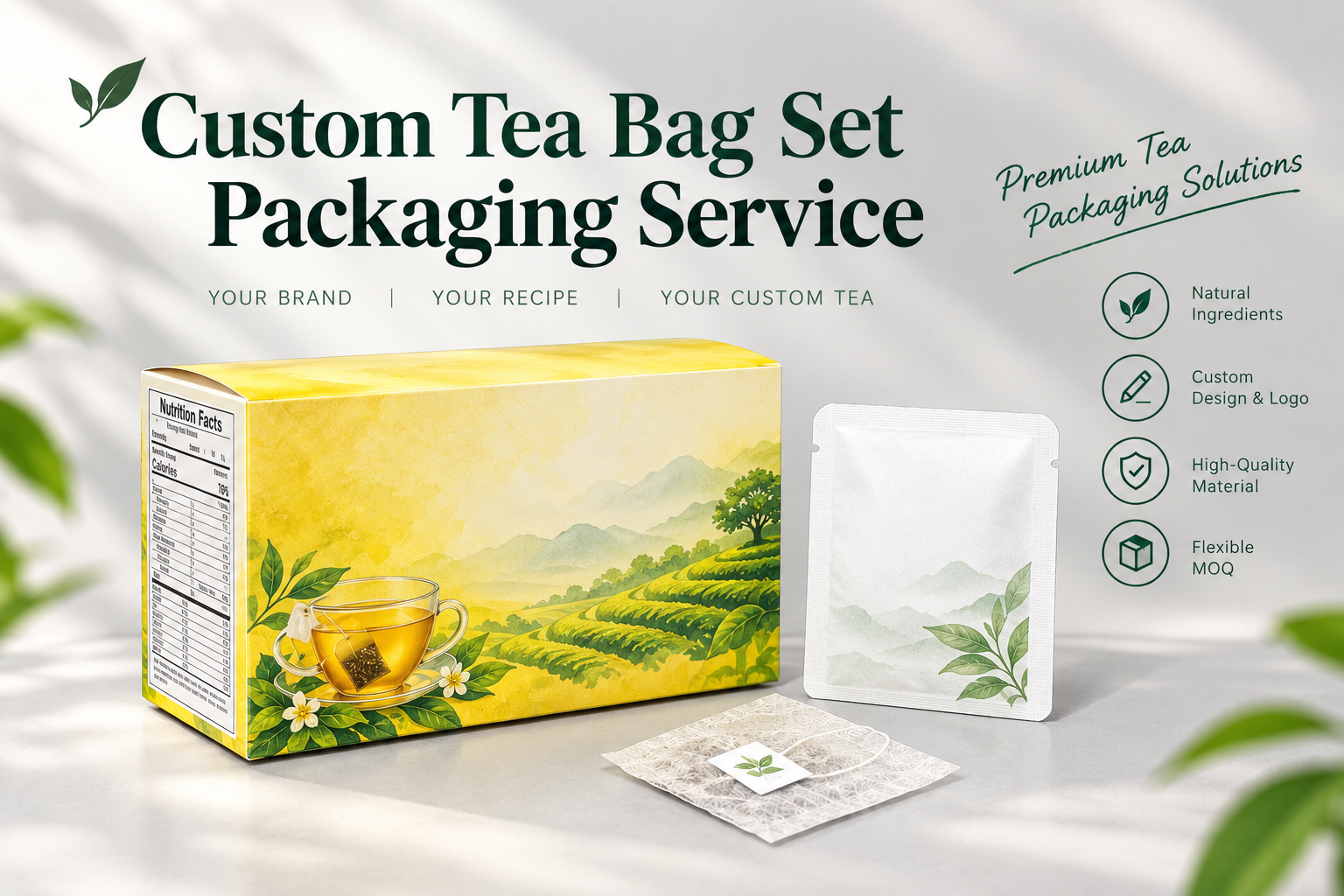
What Are Custom Tea Bag Manufacturing Services?
At an industrial scale, custom tea bag manufacturing services refer to end-to-end contract packaging (co-packing) and precision converting solutions that transform bulk tea, herbs, and botanicals into fully branded, portion-dosed, retail-ready, or food-service-ready finished goods.
Rather than forcing a standardized, one-size-fits-all filter onto delicate whole-leaf teas or fine-cut botanical blends, custom contract manufacturing allows buyers to configure every layer of the primary and secondary packaging architecture:
┌────────────────────────────────────────────────────────┐
│             CUSTOM TEA PACKAGING ARCHITECTURE          │
├────────────────────────────────────────────────────────┤
│  1. Primary Filter Web:  PLA woven mesh, non-woven,    │
│                          or abacá cellulose paper.     │
│  2. Attachment Method:   Acoustic ultrasonic welding   │
│                          (100% glue-free & staple-free)│
│  3. Custom Tag:          FSC paperboard, soy/water ink │
│  4. Drawstring:          Organic cotton or pure PLA    │
│  5. Secondary Envelope:  Foil-lined, paper, or bio-film│
│                          with optional nitrogen-flush  │
│  6. Master Pack:         Display caddies, tins, pouches│
└────────────────────────────────────────────────────────┘
A complete manufacturing partner handles the mechanical interface between the dosing systems and packaging roll stock, manages quality assurance (QA) through metal detection and checkweighers, and supplies the certified laboratory documentation required to clear domestic and international customs.
Key Benefits of Contract Manufacturing for Enterprise Buyers
Outsourcing tea packaging to a dedicated contract manufacturer provides distinct financial, operational, and commercial advantages over running an in-house packaging facility.
                          STRATEGIC ADVANTAGES
                                    │
    ┌───────────────────────────────┼───────────────────────────────┐
    ▼                               ▼                               ▼
CapEx Avoidance              Flavor & Extraction             Brand Equity &
& Cost Control                   Engineering                  Consistency
• Eliminate machinery costs  • Pore-calibrated mesh          • High-definition tags
• Variable-cost model        • Ultrasonic seam integrity     • Exact weight dosing
• Lower operational labor    • Zero glue contamination       • Premium customer pull
1. Capital Expenditure (CapEx) Avoidance
High-speed rotary packaging equipment (such as IMA, Fuso, or Maisa lines) and ultrasonic multi-lane pyramid bag form-fill-seal (FFS) machines demand significant capital investments—often ranging from $150,000 to over $800,000 per packaging line. Beyond the initial equipment purchase, ongoing plant overhead includes climate-controlled cleanrooms, dedicated maintenance technicians, spare parts inventories, and regulatory facility audits.
Partnering with an established manufacturer transforms large fixed capital investments into a predictable, scalable variable cost per unit.
2. Tailored Extraction Kinetics and Flavor Protection
Different ingredients extract at fundamentally different rates. A finely cut CTC black tea releases liquor almost instantly, while an unbroken Bai Mu Dan white tea or a rolled Formosa Oolong requires physical space to expand up to four times its dry volume. Professional contract manufacturers calibrate web permeability, aperture dimensions (from 20 microns up to 180 microns), and sachet interior volumes to match the specific physical behavior of your botanicals.
3. Accelerated Speed-to-Market
Formulating, testing, designing, and packaging a new tea line in-house can take 12 to 18 months. An experienced manufacturing partner with pre-certified roll stock, pre-tested ultrasonic configurations, and established supply chains can compress that timeline down to 6 to 10 weeks, helping brands capitalize quickly on emerging beverage trends.
Applications Across Commercial Food Sectors
Custom tea packaging serves diverse commercial environments, each with its own operational constraints, shelf-life requirements, and consumer expectations.
      Market Segment Alignment
    │
    ┌────────────────────────────┼────────────────────────────┐
    ▼                            ▼                            ▼
Multi-Unit Restaurant        Food Delivery & Ghost       Wholesale Distributors
Chains & Hospitality               Kitchens                & Private Label
• Individually wrapped       • Puncture-resistant seal   • Retail-ready shelf caddies
• High-speed brewing         • Vapor-tight barrier       • High-margin tiered SKUs
• Consistent portioning      • Condensation protection   • Full export compliance
1. Multi-Unit Restaurant Chains and Hospitality
-
Core Need: Operational consistency, rapid infusion under high-turnover breakfast rushes, and tamper-evident packaging.
-
Optimal Solution: Single-chamber or double-chamber abacá filter paper bags packed in individual, easy-tear envelopes. Pre-measured dosing guarantees every guest experiences identical strength and flavor, regardless of staff turnover or training variations across regional franchises.
2. Food Delivery Platforms and Fast-Casual Operators
-
Core Need: Packaging durability during transit, resistance to steam and external moisture, and compact storage footprints.
-
Optimal Solution: Hermetically sealed, nitrogen-flushed barrier overwraps. When teas travel alongside hot, steaming food orders, standard paper envelopes can absorb ambient humidity, causing internal tea fannings to degrade before the customer opens the meal. Individual high-barrier foil or metallized PLA overwraps protect dry ingredients from ambient moisture.
3. Specialty Retail Brands and Wholesale Distributors
-
Core Need: High-end visual appeal, whole-leaf display, and sustainable product certifications.
-
Optimal Solution: Ultrasonic woven PLA pyramid sachets housed in custom-printed display cartons or resealable stand-up pouches. The transparent netting highlights high-grade leaf tips, dried citrus peel, and whole floral blossoms, validating premium retail price points ($12 to $25 per retail unit).
Comprehensive Buying Guide: Material and Specification Selection
Procuring custom manufacturing services requires a clear understanding of materials, mechanical capabilities, and packaging configurations. The following matrices compare key technical specifications:
Sachet Format Comparison
| Metric / Feature | Ultrasonic Pyramid Sachet | Single-Chamber Flat Bag | Double-Chamber Folded Bag | Round Pod / Pillow Bag |
| Geometry | 3D Tetrahedron | 2D Planar Envelope | 2D Interconnected Fold | Circular / Rectangular Pad |
| Material Base | Woven PLA mesh, Nylon | Heat-seal / Abacá paper | Pure unsealed abacá pulp | Wet-laid filter paper |
| Leaf Grade Match | Whole leaf, coarse cuts | Fannings, dust, fine cuts | Small-to-medium cuts | Fine cuts, cold-brew coarse |
| Expansion Room | High (40–55% free space) | Low (<20% free space) | Moderate (25–35% free space) | Restricted |
| Sealing System | Ultrasonic molecular fuse | Thermal heat-seal bar | Mechanical knot or staple | Thermal or crimped edge |
| Packaging Cost | Mid to High ($$$) \vert{} Low ($) \vert{} Moderate ($$) | Low ($) |
Customization Options Available
Experienced manufacturing specialists, including Sokoo Group, provide modular customization parameters across the full packaging bill of materials:
┌────────────────────────────────────────────────────────┐
│              MODULAR CUSTOMIZATION MATRIX              │
├────────────────────────────────────────────────────────┤
│  • Bag Dimensions:   50x60mm up to 75x85mm             │
│  • Tag Geometry:     Square, rectangular, custom die   │
│  • Tag Substrate:    FSC white paperboard, kraft paper │
│  • Inks:             Food-contact water/soy (1-6 colors)│
│  • Thread Length:    110mm to 170mm options            │
│  • Overwraps:        Matte, gloss, metallized, kraft   │
│  • Gas Flushing:     Nitrogen injection (<1.0% O2)     │
└────────────────────────────────────────────────────────┘
-
Tag Customization: Custom die-cut shapes, double-sided CMYK plus spot PMS printing, variable QR code integration for origin tracking, and anti-bleed paper stocks that prevent ink leaching into boiling water.
-
String Construction: Thread material matched to your chosen waste stream—pure unbleached natural cotton for organic/home-compostable lines, or continuous monofilament PLA for industrial compost programs.
-
Barrier Overwraps: Secondary envelopes customized with tear notches, gas-valve integration, soft-touch matte varnishes, cold-foil stamping, or high-barrier metallized compostable films.
Sourcing Parameters: MOQs, Timelines, and Cost Drivers
Managing lead times and cash flow requires an understanding of standard minimum order quantities (MOQs) and the primary variables that drive contract manufacturing pricing.
    Manufacturing Turnaround Timeline
    │
    ┌─────────────────────────────┼─────────────────────────────┐
 ▼                          ▼                       ▼
Proofing & Tooling          Mass Production            Quality & Transit
  (Weeks 1 - 2)              (Weeks 3 - 5)               (Weeks 6 - 8)
• Tag plate engraving       • FFS automated running    • QA micro-testing
• Film print sign-off       • Checkweighing & boxing   • Export customs clearance
• Pilot sample approval     • Master carton palletizing • Ocean/Air logistics
Minimum Order Quantities (MOQs)
MOQ thresholds are typically determined by the printing press setup for custom tags and secondary foil films rather than the bulk tea fill process:
-
Plain Stock Sachet Filling: 10,000 to 25,000 units (using generic or unprinted tags).
-
Fully Customized Printed Tags & Roll Stock: 50,000 to 100,000 units.
-
Custom Printed Secondary Barrier Overwraps: 100,000 units (driven by standard flexographic or rotogravure printing cylinder runs).
Primary Cost Drivers
-
Filter Web Substrate: High-purity, certified woven PLA mesh carries a price premium over commodity wood-pulp filter papers due to raw biopolymer extraction and monofilament textile processing costs.
-
Ultrasonic Tooling and Run Speeds: Pyramid machines operate at 50 to 90 bags per minute per lane, whereas rotary flat-bag machines exceed 400 to 1,500 bags per minute. Slower run speeds correlate directly to higher machine-hour conversion costs.
-
Secondary Packaging Labor: Bulk packaging into 1,000-count food service cartons represents the lowest conversion cost. Manually placing 15 individually overwrapped sachets into a retail folding box with inner trays increases packaging labor and assembly costs.
Common Buyer Concerns and Mitigation Strategies
When sourcing contract manufacturing services, enterprise purchasing managers frequently face specific operational and commercial risks:
                    CRITICAL BUYER CONCERNS
                       │
     ┌──────────────────┬──────────────┴─────┬──────────────────┐
     ▼                  ▼                    ▼                  ▼
Lead Leakage & Dust    Ultrasonic Seal      Microplastics &     Greenwashing &
Contamination          Rupture under Heat   Toxicity Risks      Compliance Traps
(Dust leaking from     (Seams failing in    (Chemical leaching  (Unverified compost
 loose mesh apertures)  near-boiling water)  from hot nylon/PET) claims in target markets)
Concern 1: “Tea Dust” Leaking Through Open Mesh
-
The Problem: Whole-leaf blends frequently contain small amounts of broken leaf fragments and dust. If packed into an open-weave mesh (e.g., 140-micron aperture), fine particles sift through the pores during transport, coating the interior of the box with unsightly residue.
-
The Solution: Require your contract manufacturer to integrate mechanical dust-sifting screens into the leaf-feeding hoppers prior to dosing. Alternatively, select fine-mesh variants (e.g., 100-micron density) or hybrid spunbond non-wovens for blends containing fragile dried herbs.
Concern 2: Seam Rupture in Boiling Water
-
The Problem: Poorly calibrated ultrasonic horns can either burn through thin biopolymer webs (creating pinholes) or deliver insufficient acoustic energy, resulting in cold welds that split when water at 100°C is poured directly onto the sachet.
-
The Solution: Demand that your manufacturer establish documented seam-integrity tensile testing protocols (minimum breaking force $>0.5\text{ kN/m}$) and perform routine hot-water drop-testing on every production run. Working with experienced packaging converters like Sokoo Group ensures strict digital calibration of ultrasonic frequencies and continuous seam-pressure monitoring throughout production.
Concern 3: Regulatory Compliance and Chemical Migration
-
The Problem: Importing tea bags that lack validated food-contact documentation can lead to costly border detentions by customs authorities such as the US FDA or European border inspectors.
-
The Solution: Never accept generic material claims. Mandate batch-traceable test reports from accredited third-party laboratories (e.g., SGS, TÜV, Intertek) confirming full compliance with:
-
US FDA: 21 CFR § 176.170 (paper) / 21 CFR § 177.1630 (polymers).
-
European Union: Regulation (EC) No 1935/2004, Regulation (EU) No 10/2011, and German LFGB.
-
Compostability: EN 13432 or ASTM D6400 (industrial composting), or TÜV OK compost HOME.
-
Frequently Asked Questions (FAQ)
1. What is the typical shelf life of custom-manufactured tea bags?
Unopened tea bags sealed inside high-barrier secondary foil or metallized envelopes with a nitrogen-flushed headspace ($<1.0\%\text{ O}_2$) typically maintain a commercial shelf life of 18 to 24 months. Tea packed in porous outer cartons without individual barrier envelopes should generally be consumed within 6 to 12 months to prevent volatile aromatic dissipation and ambient moisture absorption.
2. Can we provide our own proprietary tea blends for contract packing?
Yes. Professional custom packaging manufacturers routinely operate under toll-blending or contract-filling arrangements. You ship your blended botanicals in bulk (typically in food-grade lined multi-wall paper sacks or bulk totes), and the contract manufacturer manages climate-controlled warehousing, dosing, packaging, and final palletization.
3. What is the difference between ultrasonic sealing and heat sealing?
Heat sealing relies on thermal conduction bars that melt a low-temperature plastic resin (such as polypropylene) blended into the filter paper, which fuses the edges under pressure. Ultrasonic sealing uses acoustic high-frequency vibrations (20–40 kHz) to generate localized frictional heat directly within thermoplastic fibers (like PLA). Ultrasonic welding is cleaner, consumes less energy, requires zero chemical glues, and leaves no scorched paper edges.
4. How can we verify that our PLA tea bags are truly non-GMO?
Legitimate biopolymer manufacturers provide Chain of Custody (CoC) certification alongside analytical testing reports (such as PCR testing or supplier bio-origin tracing). Sourcing partners should deliver verified proof that the precursor dextrose originated from identity-preserved, non-genetically modified plant sources.
5. What printing files are required to initiate custom tag production?
Clients typically provide vector artwork files (Adobe Illustrator
.ai or vector .pdf) configured with fonts outlined, bleed margins of at least 2.0 mm, and color profiles clearly designated as either CMYK or specific Pantone Matching System (PMS) spot codes. The packaging partner’s prepress team will then generate mechanical proofs for engineering sign-off.Strategic Procurement Outlook
Transitioning to high-performance, sustainable custom tea packaging is one of the most effective ways for beverage brands, restaurant chains, and wholesale distributors to protect product margins, meet tightening global environmental mandates, and elevate customer satisfaction.
Successful packaging execution requires moving beyond transactional material purchasing. It demands a technical manufacturing partnership that aligns material science, automated packaging line tolerances, food contact compliance, and reliable global fulfillment.
Build Your Custom Beverage Packaging Program with Sokoo Group
Sokoo Group delivers certified, end-to-end tea filtration materials and custom converting manufacturing services engineered for the world’s most demanding food service and retail brands:
-
Certified Clean-Label Materials: Fully verified food-grade, non-GMO woven PLA mesh, unbleached abacá filter papers, and high-barrier compostable secondary overwraps complying with FDA, EU No 10/2011, and LFGB safety frameworks.
-
Precision Converting Capabilities: High-speed ultrasonic string-and-tag attachment, clean-cut micro-slitting, custom tag printing using non-toxic inks, and automated high-barrier pouch filling.
-
Scalable Global Supply: Reliable production scaling, flexible tiered MOQs for qualified brand partners, and end-to-end export compliance documentation.
Elevate your commercial tea packaging program. Visit sokoogroup.com or contact sales@sokoogroup.com today to request technical product data sheets, book an engineering consultation, and receive a free certified sample kit.
Post time: Sep-30-2026


