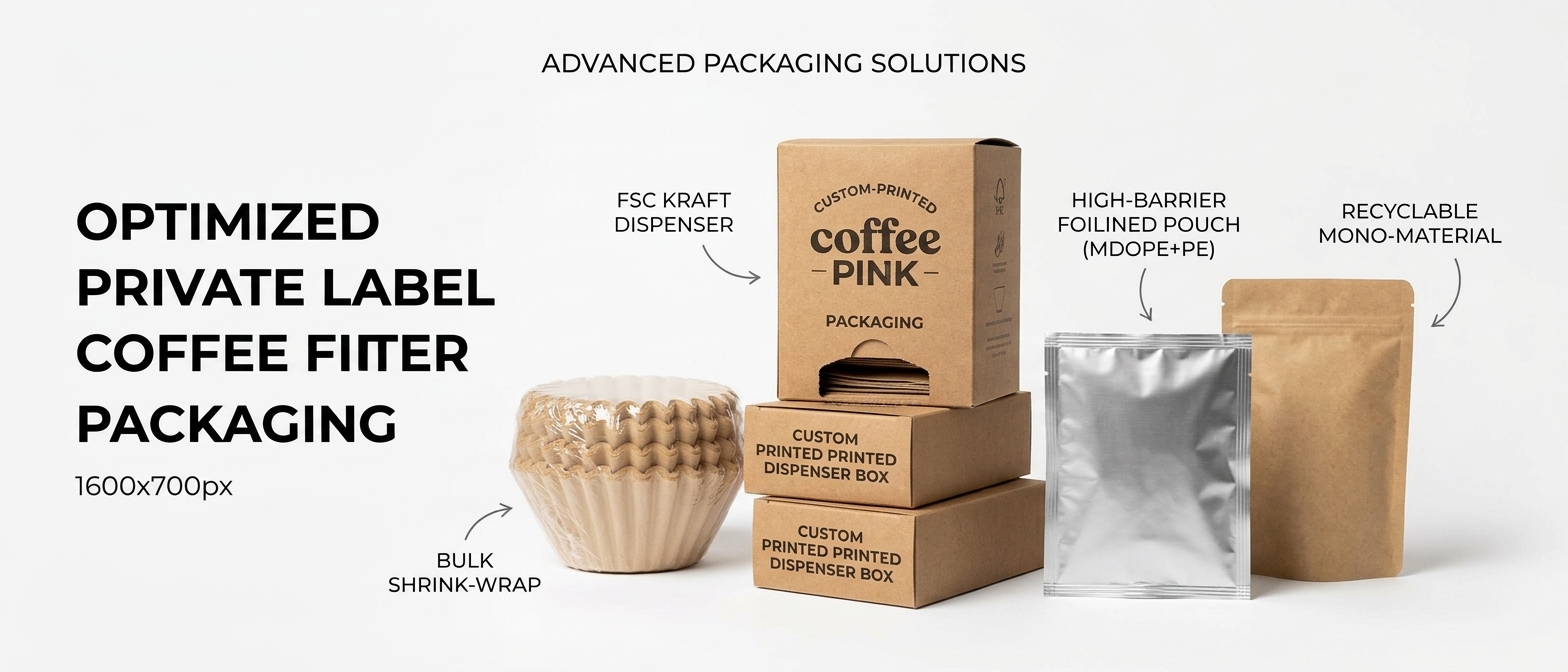
In the highly competitive specialty coffee market, roasters and lifestyle brands are constantly seeking ways to differentiate their products and achieve higher profits. While sourcing high-quality green beans and perfecting roasting processes are crucial, the brewing equipment itself is also a key and often overlooked element. Ensuring a stable supply of custom coffee filters allows private label brands to control the entire customer experience from opening the bag to the final extraction.
I Advantages of Own Brand Filtration
The shift from off-the-shelf coffee filters to private-label filters transforms coffee filters from ordinary commodities into strategic brand assets. Brand loyalty grows as consumers use filters designed specifically for your roasting curve, paired with packaging that echoes your brand aesthetic.
Product Overview
At the heart of custom coffee filters is a semi-permeable cellulose membrane designed to meet specific extraction parameters. Unlike mass-produced filters on supermarket shelves, private-label filters use precise grammage (GSM), specific fiber blends, and proprietary pleats. This ensures consistent filter performance, highlighting the flavor profiles the roaster wants to achieve while avoiding issues like extraction stalls or chemical off-flavors.
Its application scope covers all stages of brewing.
Private label projects can be tailored to cover all aspects of modern coffee consumption:
Pour-over coffee
The preferred brewing method for specialty coffee shops and serious coffee enthusiasts. Custom V60 or Kalita-style filters ensure optimal clarity and acidity for light roast single-origin coffees.
UFO drip coffee bags
A rapidly growing category in the portable coffee market. Custom-designed non-woven material allows roasters to deliver café-quality drip coffee in hotel rooms, offices, and outdoor locations.
Commercial bulk brewers
Featuring a heavy-duty flat-bottomed basket filter, designed specifically for high-volume coffee shops. Printing your brand logo on these large boxes will make your mark stand out.
Espresso puck filter
A precision-cut, round paper filter placed above or below the espresso puck to improve extraction and keep the shower filter clean.
Core Business Advantages
Developing a dedicated filter production line can create a sustainable revenue stream. Customers who buy your retail coffee bags are more likely to add your branded filter paper to their carts, increasing average order value (AOV). Furthermore, custom filter paper allows you to control the flow rate. If your signature roast coffee has a thick, coarse texture and tends to produce fine dust that clogs standard filter paper, you can choose a highly porosity abaca blend filter paper to ensure perfect extraction time, thus guaranteeing the final coffee quality and reducing customer complaints.
II Materials Engineering and Customization
The foundation of any high-quality filter cartridge lies in its fiber matrix. The physical properties of the filter paper determine its hydrostatic resistance, wet burst strength, and sensory neutrality.
Raw Materials and Fiber Science
Custom Toolkit
III Supply Chain Dynamics and Compliance
Minimum Order Quantity (MOQ)
| Requirement Level | Specifications | MOQ Range |
|---|---|---|
| Standard Paper / Custom Packaging | 50 g/m² abaca blend paper + custom printed boxes. | 20,000 – 50,000 units |
| Custom-made Paper | Unique basis weight, specific fiber ratios, or watermarks. | 2 – 3 tons of base paper |
Production and delivery cycle
Reliable inventory forecasting is crucial. Initial production of private-label products, including digital prototyping, 3D packaging model making, and physical sample testing, typically takes 10 to 14 days. Once approved, mass production takes 20 to 30 working days. For international shipping, full container load (FCL) in 40-foot high cube containers is recommended to reduce landed cost and prevent moisture damage, adding 25 to 35 days to the sea freight time.
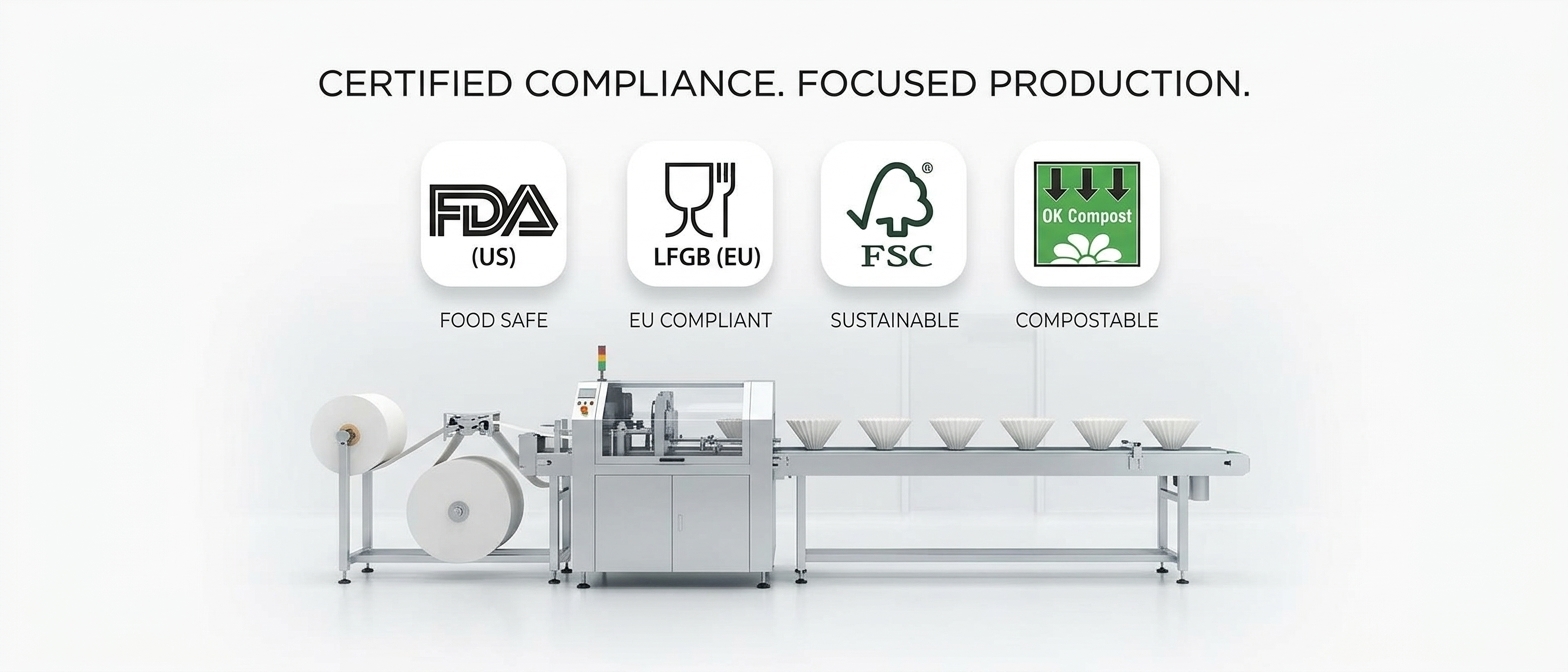
International certification and compliance
IV Strategic Procurement Tools
To simplify supplier evaluation and clarify technical specifications, please use the following comparison data and frequently asked questions.
Q: Does adding abaca fiber significantly increase the unit cost?
Yes, abaca is a high-quality plant fiber with a commodity index higher than that of regular softwood pulp. However, its performance enhancements—particularly eliminating brewing stagnation and improving flavor clarity—more than compensate for the slight increase in cost per unit for premium brands.
Q: Can we heat-seal standard paper filters for use in our automatic drip coffee makers?
No. Pure virgin cellulose is not thermoplastic and cannot be heat-sealed. If you want to produce sealed single-serve coffee capsules or hanging drip bags, you must specify a nonwoven composite material (containing PLA or synthetic bicomponent fibers).
Q: How can we prevent paper from absorbing odors during sea transport?
Filter paper can absorb environmental odors like a carbon sponge. Manufacturers must use high-strength polyethylene stretch film to palletize goods and place high-capacity desiccant inside the pallets, avoiding containers with odorous goods.
Q: Is it possible to emboss our logo directly onto the edge of the filter paper?
Yes. Mechanical edge embossing wheels can be custom-molded to imprint repeating micro-logos or specific geometric patterns onto the seams. This requires an initial mold fee but adds a superior level of detail to the final product.
Launching its own filtration production line signifies a brand’s transformation from a mere coffee supplier to a standard-setter in coffee brewing. By controlling fiber composition, extraction mechanisms, and retail aesthetics, the company can protect its roasting characteristics and ensure its products maintain a strong position on customers’ tables. When evaluating potential production partners to complete this transformation, what specific extraction challenges or packaging aesthetics do you hope to address with your initial customized products?
Post time: Sep-30-2026


