
The Ultimate B2B Buyer’s Guide: Coffee Filter Paper GSM and Grammage Selection
In the manufacturing and distribution of specialty coffee filtration products, one technical metric dictates brewing performance more than almost any other: basis weight, globally measured as GSM (grams per square meter). For roasters, contract packagers (co-packers), and coffee brand owners, selecting the appropriate coffee filter paper gsm determines the boundary between a pristine, aromatic brew and a clogged, bitter extraction.
Understanding GSM is not simply a matter of paper thickness; it directly governs porosity, hydrostatic resistance, wet tensile strength, and drawdown velocity across various extraction systems. Whether engineering single-serve hanging ear drip bags or supplying batch brew cones to commercial cafe chains, matching the target extraction profile with the correct grammage is foundational to commercial success.
1. Product Overview: Demystifying GSM in Coffee Filtration
GSM (Grams per Square Meter) represents the areal mass of filter paper. In industrial papermaking, grammage is precisely calibrated during the slurry deposition and web-forming stages on the paper machine wire.
In liquid food filtration, the metric serves as a primary proxy for density, fiber entanglement, and structural integrity under hydraulic pressure:
-
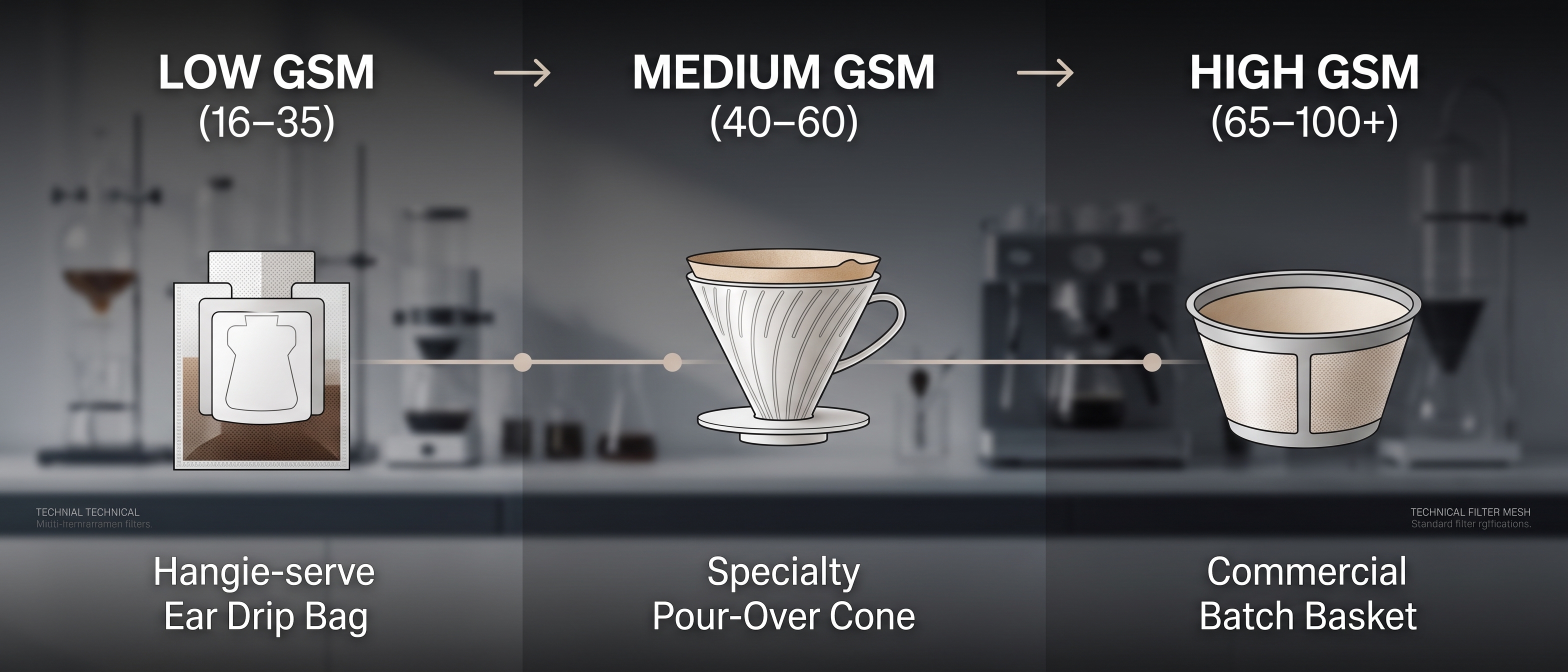
Low Grammage (16–35 GSM): Characterized by high air and liquid permeability, rapid capillary flow, and minimal contact time. Commonly used in non-woven heat-sealable filters, pod membranes, and specialized single-serve solutions.
-
Medium Grammage (40–60 GSM): The global benchmark for manual pour-over brewers (V60, Kalita, Chemex-style paper) and domestic drip machines. Balances particulate retention with consistent flow rates.
-
High Grammage (65–100+ GSM): Heavy-duty, deep-bed filtration media engineered for commercial batch brewing, industrial extractors, and cold brew containment vessels where hydrostatic load and burst potential are substantial.
Selecting the optimal coffee filter paper gsm requires balancing extraction yield (TDS) against drawdown speed while preventing premature clogging caused by coffee fines (insoluble particulates under 100 microns).
2. Materials, Fiber Matrix, and GSM Interactions
The physical weight of the paper is inseparable from the fiber blend used to create it. Two sheets of 50 GSM filter paper can exhibit radically different flow characteristics depending on their botanical composition and processing.
Virgin Long-Fiber Wood Pulp
-
Sourced primarily from softwood conifers (such as spruce, pine, or fir) grown in certified sustainably managed forests.
-
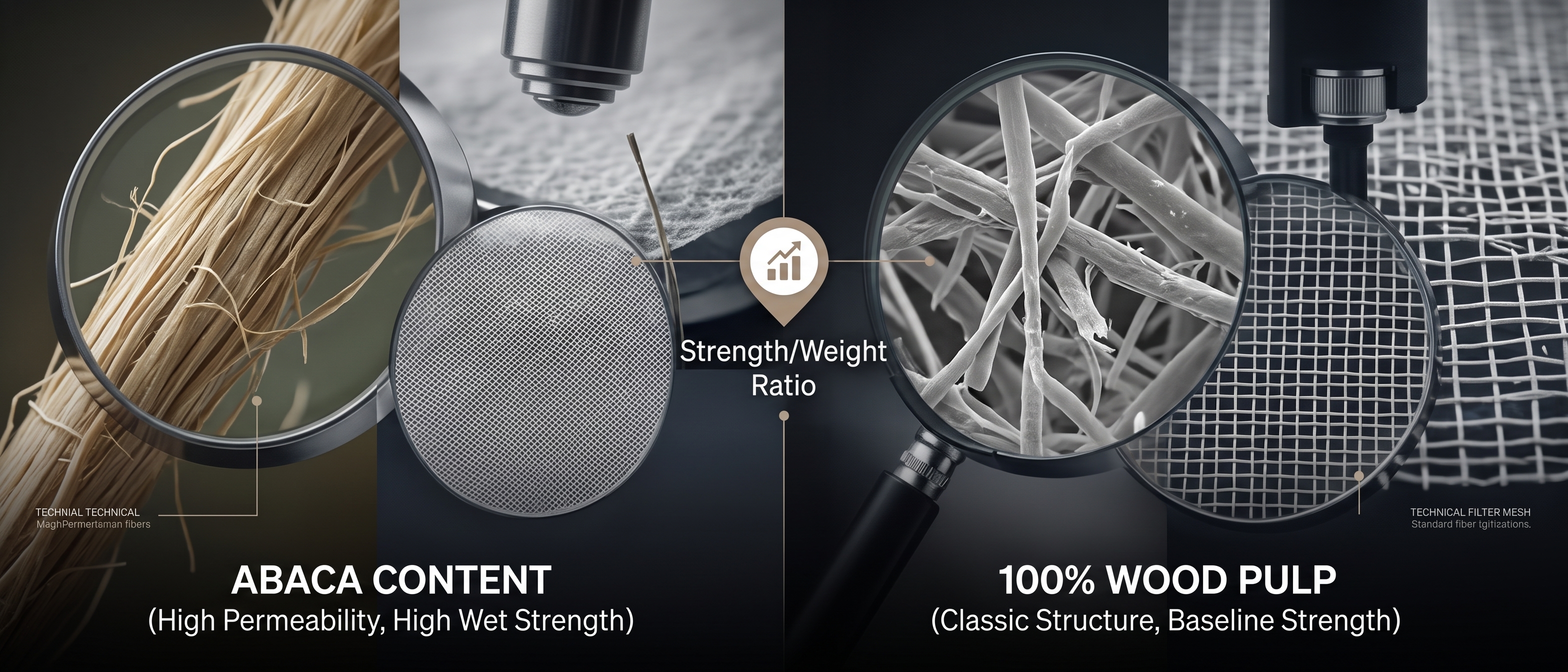
Provides the foundational web structure and micro-porosity. Long cellulose fibers yield significant physical entanglement, which provides the baseline tensile stability needed across standard 45–60 GSM papers.
Abaca (Manila Hemp) Fibers
-
Derived from Musa textilis, high-end specialty papers incorporate between 20% to 50% abaca pulp.
-
Abaca fibers possess exceptionally high aspect ratios (length-to-width) and natural wet strength. By integrating abaca, paper mills can reduce the overall coffee filter paper gsm down to 40–45 GSM while matching or exceeding the burst strength of a 60 GSM pure wood pulp sheet, all while increasing liquid permeability and flow consistency.
Bleaching Treatments and Grammage Impact
-
TCF (Totally Chlorine-Free): Bleached using oxygen, ozone, or hydrogen peroxide. This process removes natural lignins cleanly without degrading fiber length, maintaining tight GSM tolerances and zero chemical off-flavor.
-
Unbleached (Natural Kraft): Retains residual wood lignins. Because the fibers retain more natural organic mass, unbleached papers at a given GSM tend to be marginally denser with slightly slower flow rates than their oxygen-bleached counterparts.
3. Application Spectrum: Matching Brew Methods with Ideal GSM
Selecting the right grammage depends entirely on brewer geometry, bed depth, grind distribution, and hydrostatic head pressure.
Specialty Manual Pour-Over (Conical & Flat-Bottom)
-
Target Grammage: 45 – 55 GSM
-
Operational Context: Conical brewers (such as V60 style) rely on gravity and the capillary draw of the vertical flutes. A 48–52 GSM abaca-wood blend delivers balanced water retention, trapping fines along the upper cone while allowing clarity in delicate light-roast single origins.
Hanging Ear & UFO Drip Filter Bags
-
Target Grammage: 22 – 35 GSM
-
Operational Context: Single-serve drip formats operate without the support of an external funnel or ceramic wall. They require non-woven, food-grade composite fibers (often incorporating ultrasonic-sealable PLA or PE/PET bicomponent fibers). The low GSM ensures immediate drawdown under zero head pressure, preventing grounds from overflowing the top opening.
Commercial Batch Brewers (Flat-Bottom Baskets)
-
Target Grammage: 65 – 85 GSM
-
Operational Context: Designed for high-volume urns and commercial cafe batch brewers processing 2 to 6 liters per cycle. The immense weight of saturated grounds (often 100g to 300g+) requires a substantial basis weight to prevent base puncture and side-wall collapse during high-flow spray dispersion.
Cold Brew Immersion and Industrial Extractors
-
Target Grammage: 80 – 110 GSM (or multi-ply configurations)
-
Operational Context: Cold water extraction lacks heat to break down surface tensions, and prolonged steeping (12–24 hours) saturates cellulose structures. Heavyweight paper prevents tearing when lifting dense, wet grounds out of immersion tanks.
4. Technical Advantages: The Mechanics of Proper GSM Selection
Dialing in the correct coffee filter paper gsm delivers measurable performance benefits across commercial brewing parameters:
-
Precise Flow Rate Control: Dialing in grammage allows roasters to tailor drawdown curves to their roast profiles. Lighter roasts produce more brittle fines during grinding; pairing them with an optimized 45 GSM high-porosity abaca sheet prevents fine-migration stalls.
-
Maximized Wet Burst Strength: When paper absorbs boiling water, standard hydrogen bonding between cellulose chains weakens by up to 90%. High-spec filter papers maintain wet tensile strength through mechanical fiber refining (fibrillation) rather than synthetic wet-strength resins. Proper GSM ensures the wet burst factor easily withstands 15–25 kPa of head pressure.
-
Total Dissolved Solids (TDS) Uniformity: Inconsistent GSM across a production roll creates erratic channeling. Certified uniform grammage ensures extraction yields remain within the Gold Cup standard (18%–22%) batch after batch.
-
Odor and Flavor Neutrality: Properly calibrated, food-grade virgin paper leaves zero residual cellulose taste when hot water passes through, eliminating off-putting flavors even if the end user omits a pre-wetting step.
5. Technical Comparison Table
| Application Format | Typical GSM Range | Primary Fiber Composition | Flow Rate Characteristic | Wet Tensile Strength | Recommended Roast / Method |
|---|---|---|---|---|---|
| UFO / Drip Bags | 22 – 32 GSM | PLA / Synthetic non-woven blend | Ultra-Fast | Medium (Seam-welded) | Single-serve, Medium/Coarse |
| Specialty Pour-Over (V01/V02) | 45 – 52 GSM | Virgin Wood Pulp + Abaca | Fast / Controlled | High (Creped surface) | Light to Medium Roasts |
| Dense Pour-Over (Chemex Style) | 65 – 75 GSM | 100% Virgin Softwood Pulp | Medium / Slow | Exceptionally High | Bright, Clean, Zero Sediment |
| Commercial Batch Brewer | 60 – 80 GSM | Long-fiber Refined Wood Pulp | Steady / High Volume | Very High (Burst-resistant) | Medium/Dark Commercial Batches |
| Cold Brew Filtration | 85 – 110 GSM | Multi-ply Cellulose or Heavy Kraft | Low / Deep Immersion | Maximum Heavy-Load Strength | Coarse Cold Brew Immersion |
6. Customization and Secondary Packaging Integration
Procuring filter paper is rarely an isolated supply chain event. For commercial brands and co-packers, integrating paper specifications with custom converting and barrier packaging creates a cohesive product.
-
Converting and Die-Cutting: Precision die-cutting handles high and low GSM rolls without edge-fraying. We convert master rolls into standard cones (#01, #02, #04), circular puck screens, flat-bottom basket ripples, and customized trapezoidal sheets.
-
Surface Creping Adjustments: Creping alters the effective surface area without changing the base GSM. Two-sided creping expands total filtering area, allowing a heavier 55 GSM paper to drain as fast as a flat 45 GSM paper while trapping more micro-fines.
-
Outer Barrier Packaging Integration: Coffee filters, especially lower GSM open-mesh papers, are hygroscopic and absorb atmospheric volatile organic compounds (VOCs) and moisture. To preserve purity:
-
Retail filters should be enclosed in recyclable mono-material barrier pouches (such as MDOPE+PE) or high-barrier foil laminates (EVOH+PE) to prevent environmental odor migration during containerized ocean transit and warehouse storage.
-
For single-serve drip lines, matching 26 GSM drip-bag rolls with automated form-fill-seal outer pouches ensures nitrogen flushing maintains residual oxygen under 1%, preserving the grounds until brewing.
-
7. Commercial Terms: MOQ and Sourcing Economics
Navigating paper procurement requires understanding paper machine scale. Pulp mills operate on continuous master-roll widths (often 1200mm to 2400mm), meaning custom grammage runs require substantial minimum volume commitments.
-
Standard Grammage Converting (Stock Calipers: 45, 50, 56 GSM):
-
MOQ: 10,000 to 50,000 retail packs (e.g., 40–100 filters per pack in custom-printed kraft boxes or printed pouches).
-
Ideal for established roasters introducing branded pour-over filters without raw-paper mill minimums.
-
-
Bespoke GSM Milling (Custom Basis Weight / Unique Abaca Blend Ratios):
-
MOQ: 1.5 to 3 Metric Tons of raw slit-roll stock.
-
Required for proprietary shapes, fully integrated co-packers, or custom automated packaging lines using continuous unwind reels.
-
8. Lead Time and Logistics Engineering
Consistent lead times safeguard roaster schedules and co-packing contracts against costly downtime.
-
Production Cycles:
-
Standard converting & OEM printed packaging: 15 to 25 business days following final prepress sign-off.
-
Custom mill runs (bespoke basis weight synthesis): 30 to 45 business days.
-
-
Container Consolidation and Volume Economics:
-
Filter paper exhibits low bulk density and high volumetric displacement. Shipping LCL (Less than Container Load) exposes paper to moisture fluctuations, crushing risks, and disproportionate freight costs.
-
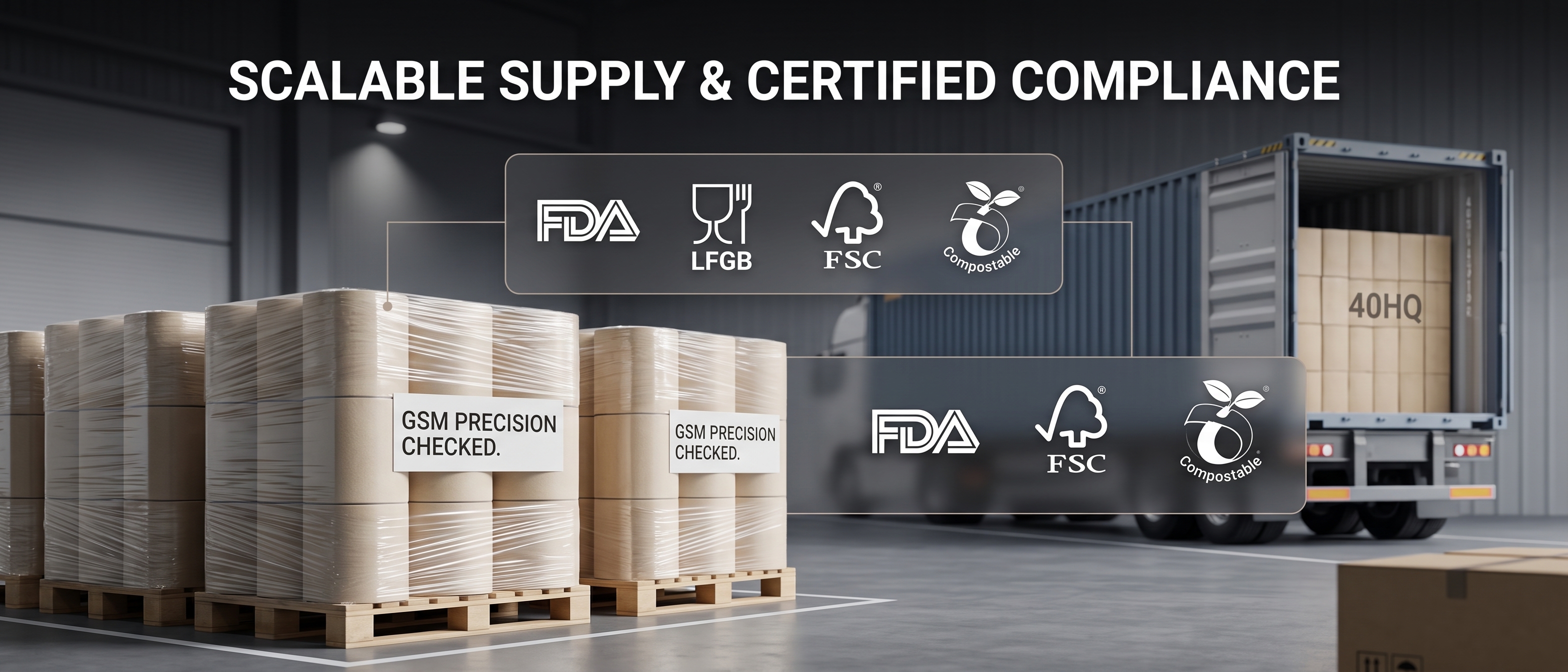
Full container loads (40HQ) optimize freight economics by maximizing internal cube capacity. Pallet configurations must balance structural stability with moisture barriers (wrapping each pallet in heavy PE stretch film with internal desiccant packs).
-
9. International Certificates and Food Contact Compliance
Because filter paper operates at temperatures between 90°C and 98°C, regulatory scrutiny regarding chemical leaching is critical. High-quality coffee filter paper gsm must be backed by transparent, third-party laboratory verification:
-
FDA 21 CFR 176.170 & 176.180: US standard for components of paper and paperboard in contact with aqueous, fatty, and dry foods, verifying safe chloroform-soluble extractives.
-
LFGB (Lebensmittel-, Bedarfsgegenstände- und Futtermittelgesetzbuch): European standard (specifically BfR Recommendation XXXVI). Tests for sensory neutrality, heavy metal migration (lead, cadmium), and primary aromatic amines.
-
FSC (Forest Stewardship Council) Chain of Custody: FSC-Mix or FSC-100% certification proving wood fibers originate from deforestation-free, responsibly managed timber lands.
-
Compostability Certification (EN 13432 / ASTM D6400): Guarantees the unbleached or oxygen-bleached cellulose decomposes cleanly into biomass, water, and CO2 within commercial composting cycles, leaving zero synthetic microplastic residues.
10. Frequently Asked Questions (FAQ)
Does a higher GSM automatically mean a stronger filter paper?
Not necessarily. Wet strength depends on fiber length, refining, and wet-strength bonding mechanisms. A 45 GSM sheet containing 40% long-strand Abaca fiber often exhibits higher wet tensile and burst strength than a 55 GSM sheet made exclusively from short-fiber recycled or unrefined hardwood pulp.
Why does my pour-over stall when using heavy-weight filter paper?
Heavier paper (60+ GSM) often features smaller pore sizes and a denser tortuous path for water. If the coffee grind contains a high proportion of micro-fines (common with flat burr grinders or light, dense African coffees), those fines migrate into the paper matrix, clogging the internal channels and stalling extraction.
Can we heat-seal 50 GSM wood pulp filter paper?
Pure cellulose wood pulp does not melt and cannot be heat-sealed without the addition of a thermoplastic binding fiber (such as PLA, PP, or PE). For heat-sealed drip bags or pods, non-woven composite materials in the 22–30 GSM range are standard. Traditional 45–60 GSM papers rely on ultrasonic sealing, adhesive-free mechanical embossing, or folding.
What is the tolerance variation for commercial coffee paper GSM?
In high-precision paper manufacturing, acceptable industry variance is typically within $\pm 2$ to $\pm 3\text{ GSM}$. Anything wider causes noticeable inconsistencies in brew times across a single pack of filters.
How does creping affect basis weight measurement?
Basis weight is always determined on the finished creped paper sheet. However, the creping process compacts the paper web, introducing micro-ridges that artificially increase the caliper (thickness) and functional surface area relative to its uncreped state.
11. Strategic Sourcing Recommendations
Navigating coffee filter paper gsm selection is a balance of botanical science, fluid dynamics, and packaging economics. For specialty coffee brands and international B2B distributors, there is no universal “best” weight:
-
Specify 48–52 GSM TCF abaca-wood blends for high-clarity pour-over cones.
-
Utilize 24–30 GSM non-woven composites for single-serve drip configurations.
-
Reserve 70–90 GSM heavy-duty virgin kraft for commercial batch systems.
Partnering with an experienced converting and packaging manufacturer ensures tight grammage tolerances, full international food-contact compliance, and seamless integration with your retail pouches and secondary packaging. Proper alignment of these elements safeguards your brand’s reputation for exceptional extraction clarity.
Post time: Sep-04-2026


