The global beverage market is experiencing a profound shift. As consumer demand for specialty coffee intersects with increasingly stringent environmental regulations, food service operators, distributors, and restaurant chains are being forced to rethink their single-serve strategies. For years, the convenience of single-serve coffee came at a high environmental cost, heavily relying on petroleum-based plastics and aluminum pods that ended up in landfills. Today, the industry is pivoting toward a more sustainable, high-quality solution: the compostable drip coffee bag.
For procurement managers, wholesalers, and sustainable packaging buyers, navigating this transition requires a deep understanding of material science, supply chain logistics, and consumer expectations. This comprehensive guide explores the structural mechanics, commercial benefits, and purchasing criteria associated with adopting compostable single-serve coffee formats, providing a clear roadmap for B2B buyers looking to future-proof their product lines.
What Is It?
A compostable drip coffee bag is a single-use, portable brewing system designed to deliver a fresh pour-over coffee experience without the need for specialized brewing equipment. Unlike instant coffee, which is freeze-dried and soluble, this format contains real, freshly roasted, and precision-ground coffee beans.
To understand the innovation behind the compostable version, it is helpful to look at the anatomy of the product and how it contrasts with legacy packaging.
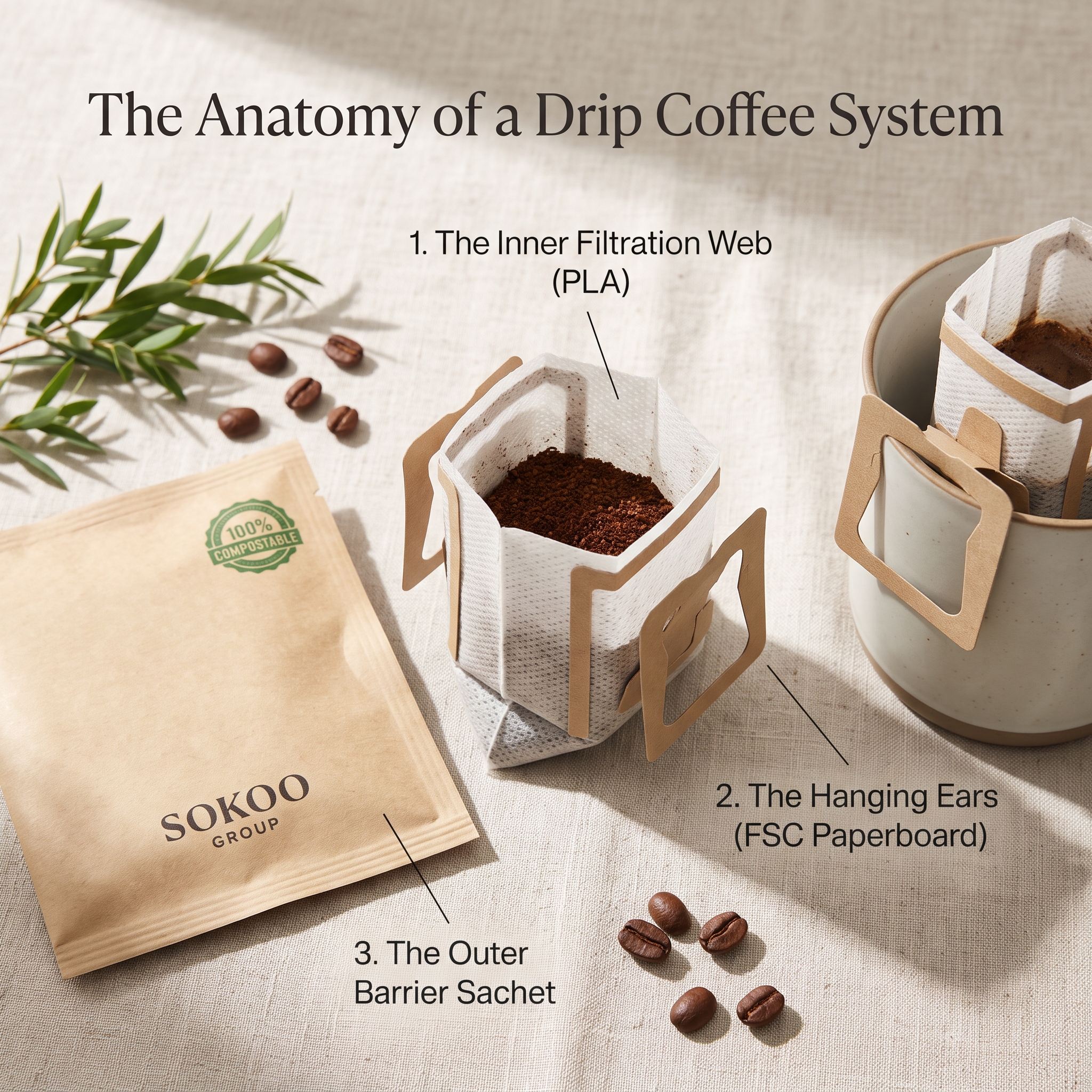
The Anatomy of a Drip Coffee System
- The Inner Filtration Web: This is the core component that holds the coffee grounds. Historically, the industry relied heavily on standard Non-woven fabric material—a synthetic blend of Polypropylene (PP) and Polyethylene Terephthalate (PET). While this petroleum-based material is cheap and features high tensile strength, it takes centuries to decompose and can release microplastics. In a compostable system, this web is replaced by Polylactic Acid (PLA), a biopolymer derived from renewable plant starches such as corn or sugarcane.
- The Hanging Ears: These are the structural supports that anchor the filter to the rim of a coffee mug. In compostable formats, these are made from food-grade, FSC-certified paperboard, attached to the filter web using ultrasonic heat sealing rather than chemical glues.
- The Outer Barrier Sachet: To preserve the volatile aromatic compounds of the coffee, the inner filter is sealed inside a protective outer envelope. For a product to be truly zero-waste, forward-thinking brands are moving away from multi-layer aluminum foils and adopting compostable barrier films made from cellulose (such as NatureFlex™) and bio-polymers.
The result is a complete packaging system that can be discarded into commercial composting facilities, breaking down into water, biomass, and carbon dioxide within 90 to 180 days, leaving no toxic residue behind.
Key Benefits
Transitioning to a compostable drip coffee bag is not merely an environmental statement; it is a strategic business decision that impacts brand equity, regulatory compliance, and product quality. For distributors and restaurant chains, the advantages are multifaceted.
1. Alignment with Corporate ESG Goals and Regulations
Governments worldwide are implementing strict bans on single-use plastics and non-recyclable packaging. By adopting compostable materials, food service buyers proactively insulate their supply chains against future legislative penalties. Furthermore, large corporate clients and hotel groups now mandate strict Environmental, Social, and Governance (ESG) criteria for their vendors.
2. Elimination of Microplastics
When near-boiling water is poured over traditional synthetic plastics, there is a documented risk of microplastic shedding into the beverage. PLA corn fiber is 100% bio-based. It provides a pure, clean extraction without introducing synthetic polymers into the consumer’s cup.
3. Superior Cup Clarity and Flavor Extraction
From a purely culinary perspective, PLA is an exceptional filtration medium. The material is completely flavor-neutral and odorless. Its microscopic pore structure is engineered to trap ultra-fine coffee dust while allowing the essential coffee oils to pass through.
4. Premium Brand Positioning
Consumers are willing to pay a premium for products that align with their ethical values. For restaurant chains and D2C brands, utilizing compostable packaging justifies a higher retail price point. The packaging itself becomes a marketing asset.
Applications
The versatility of the drip filter bag allows it to penetrate diverse commercial channels, solving unique logistical challenges for various B2B sectors.
Restaurant Chains and Cafes
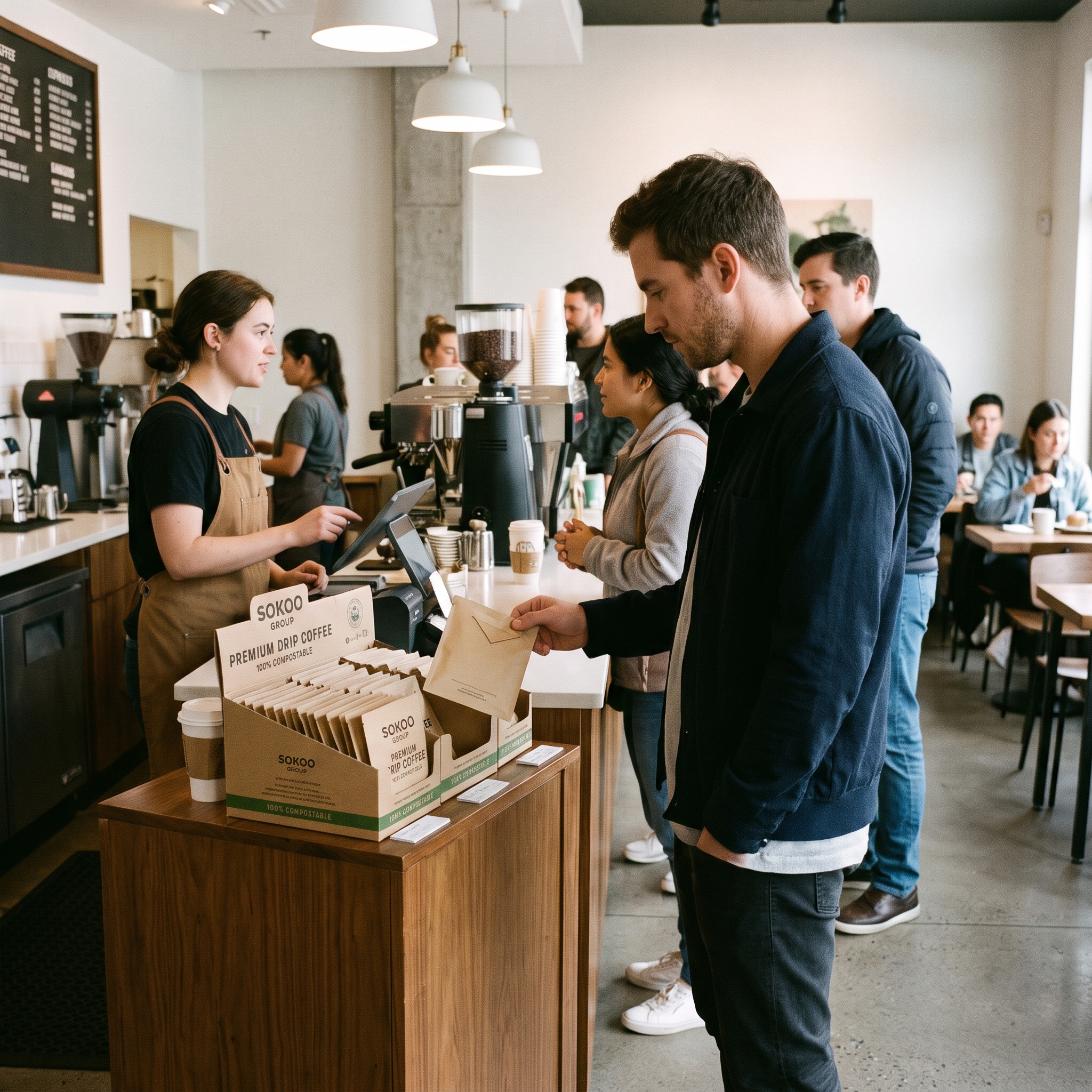
For high-volume restaurant chains, consistency and speed are paramount. While espresso machines require trained baristas and constant maintenance, single-serve pour-over bags require only hot water. Chains are increasingly utilizing these bags as high-margin retail items at the point of sale.
Food Delivery Companies
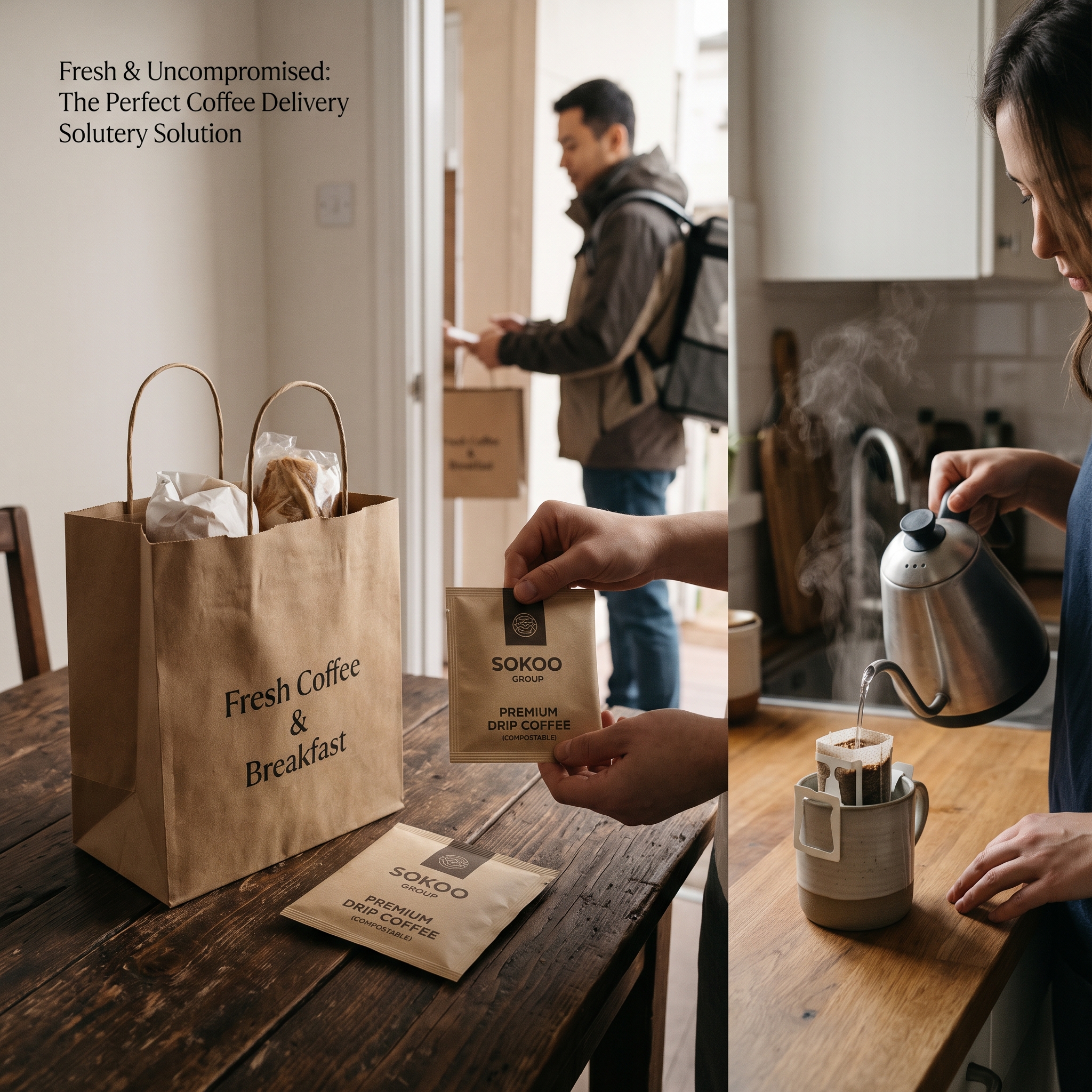
Delivering hot brewed coffee has always been a logistical nightmare. The compostable drip bag solves this elegantly. Restaurants can now include a beautifully packaged, fresh single-serve bag with breakfast orders. The customer receives a dry, uncompromised product and can brew a fresh, piping-hot cup in their own kitchen.
Luxury Hospitality and Travel
Hotels are aggressively phasing out plastic coffee pods. A beautifully branded compostable sachet placed alongside an electric kettle elevates the in-room dining experience. Similarly, airlines and cruise lines utilize this format because of its lightweight nature and Portable use.
Wholesalers and Distributors
For distributors, these products offer excellent shelf density. They are flat, lightweight, and easy to palletize, reducing shipping costs and warehousing space compared to whole bean bags or rigid plastic coffee pods.
Buying Guide
Sourcing sustainable packaging requires rigorous vetting. When navigating the procurement process, B2B buyers must evaluate materials, manufacturing capabilities, and customization options.
1. Verify Environmental Certifications
The term “biodegradable” is largely unregulated. Buyers must look for strict “compostable” certifications. Demand documentation proving compliance with EN 13432 or BPI.
2. Choose the Right Outer Packaging
- Fully Compostable Films: Made from cellulose and Kraft paper. Ideal for zero-waste mandates (9–12 months shelf life).
- Recyclable Mono-Materials (MDO-PE): The inner bag is composted, and the outer sachet is recycled in soft-plastic streams.
- Standard High-Barrier Foil: Lowest cost and maximum shelf life (18+ months), but non-recyclable.
3. Customization Options
Working with an established manufacturer like Sokoo Group allows brands to tailor every aspect:
- Inner Filter: Custom sizing for larger doses (up to 15g).
- Hanger Arms: Printed with food-safe inks for branding or instructions.
- Outer Sachet Printing: Rotogravure for high volume or digital printing for short runs.
4. Understand MOQ and Lead Times
Minimum Order Quantities (MOQs) dictate capital allocation. Generic stock MOQs: 5,000-10,000 units. Custom digital: 10,000-20,000 units. Rotogravure: 50,000+ units with 4-week lead times.
Comparison Table: Material Formats
Common Buyer Concerns
Concern 1: Shelf Life and Barrier Properties
The worry: Will compostable packaging degrade coffee faster?
The reality: Modern high-barrier compostable laminates (like NatureFlex) block light and oxygen effectively. With nitrogen flushing ($N_2$), a 9 to 12-month shelf life is confidently achieved.
Concern 2: Structural Integrity Under Heat
The worry: Will PLA mesh melt with boiling water?
The reality: PLA corn fiber is crystallized to withstand temperatures ($90^\circ\text{C} – 96^\circ\text{C}$) without bursting or dropping grounds.
Concern 3: Cost Parity and Profit Margins
The worry: Will this erode wholesale margins?
The reality: While raw costs are 20-35% higher, the “compostable” label allows for higher retail premiums that offset the cost. Partnering with Sokoo Group helps via bulk procurement.
Concern 4: Co-Packing Compatibility
The worry: Will it run on existing machinery?
The reality: Most buyers use turnkey OEM services where the manufacturer handles the technical machine adjustments during the roasting and packing process.
FAQ
1. What is the difference between biodegradable and compostable?
“Compostable” is a strictly regulated term requiring breakdown into natural elements within 90-180 days without toxic residue.
2. Can PLA drip filters be composted in a backyard garden?
Generally, no. They require industrial composting facilities’ high heat and microbial activity.
3. Does the compostable material affect the taste of the coffee?
No. PLA is entirely flavor-neutral and imparts no papery or chemical taste.
4. How much coffee can a standard drip bag hold?
Standard bags hold 8g-12g. Custom circular UFO filters can hold up to 15g.
5. How do I ensure my custom design looks good on Kraft paper materials?
Use bold, minimalist designs. Avoid detailed photographic images on porous Kraft surfaces.
Conclusion
The era of compromising environmental ethics for consumer convenience is ending. The compostable drip coffee bag represents a rare intersection in food packaging: a product that drastically reduces ecological harm while simultaneously elevating the consumer’s sensory experience.
By prioritizing verified materials and partnering with experienced global manufacturers like Sokoo Group, B2B buyers can confidently lead their respective markets, delivering cafe-quality coffee in a format that respects both the craft of the roaster and the future of the planet.
Post time: Oct-12-2026


