The Ultimate B2B Sourcing Guide
— The botanical and herbal tea sector is experiencing unprecedented growth worldwide. Driven by wellness trends, functional beverage demands, and holistic lifestyle shifts, consumers are seeking whole-flower chamomiles, coarse-cut peppermint, complex adaptogenic roots, and aromatic fruit infusions.
However, herbal teas present distinct packaging challenges compared to standard traditional teas (Camellia sinensis). Herbal ingredients vary wildly in particle size, oil content, density, and brewing mechanics. Choosing the wrong tea bag material for herbal tea brands can lead to sifting (dust leaking into the cup), slow infusion rates, seam failures, off-flavors, or regulatory non-compliance regarding plastic micro-particles.
This comprehensive guide serves as a practical blueprint for brand owners, procurement directors, product developers, and co-packers navigating the selection of high-performance, eco-friendly filter materials tailored specifically for herbal and botanical formulations.
1. Product Overview: The Critical Role of Packaging in Herbal Teas
Tea bag filter materials do more than simply hold botanicals—they serve as a dynamic membrane designed to manage extraction rates, retain particulate solids, withstand thermal shock, and deliver an unadulterated sensory experience.
|
Visual Appeal & Transparency |
|
|
Filter Material Criteria |
Dynamic Membrane Function |
|
Flavor Integrity & Zero Dust Leakage |
|
Figure 1: Core criteria for herbal tea filter material selection.
Why Herbal Teas Require Specialized Filter Media
- · Diverse Particle Morphology: Unlike uniform CTC (Crush, Tear, Curl) black tea or cut green tea, herbal blends combine delicate leaves, coarse bark, whole flower heads, heavy berries, and fine functional powders. The filter material must accommodate these structural variances.
- · Volatile Essential Oils: Ingredients such as peppermint, lemongrass, eucalyptus, and citrus peels contain high concentrations of volatile aromatic oils. The filter material must remain chemically inert to avoid absorbing or altering these delicate aromatics.
- · Consumer Expectations: Premium herbal tea buyers prioritize aesthetics, wellness, and environmental sustainability. They expect to see high-grade botanical ingredients unfurl without exposure to petroleum-based synthetic microplastics or bleached chemical residues.
2. Material Options: Science, Construction, and Types
Selecting the correct tea bag material for herbal tea brands requires an understanding of substrate properties, web structures, and sealing mechanisms.
Filter Material Classification
|
Bio-Based Polymer |
Natural Plant Fiber |
Traditional Plastic |
| PLA Mesh / Fabric | Abaca / Wood / Hemp Pulp | Nylon / PET / PE |
A. Polylactic Acid (PLA) Mesh (Woven)
- · Origin: Polymerized from plant-derived lactic acid (cornstarch, cassava, or sugarcane).
- · Characteristics: High transparency, uniform aperture size, glossy aesthetic, and strong ultrasonic sealability.
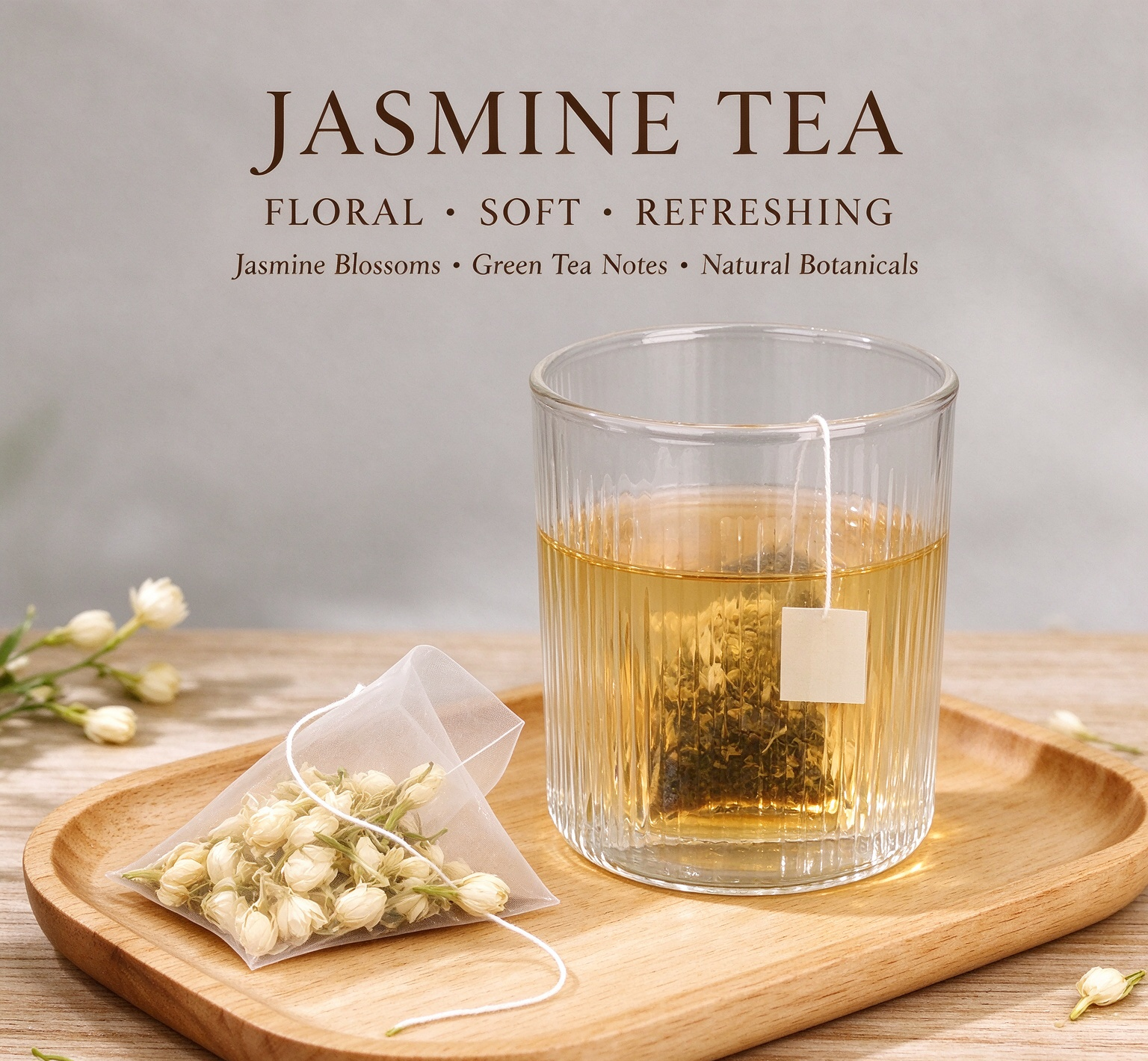
- · Best Used For: Whole flower heads (chamomile, jasmine, rosebuds), large leaf cuts (peppermint, holy basil), and visual fruit blends where high clarity is paramount.
B. Non-Woven PLA Fabric
- · Origin: Thermally bonded PLA micro-fibers forming a soft, continuous fibrous web.
- · Characteristics: High liquid permeability combined with superior particle retention. Highly heat-sealable and ultrasonically sealable.
- · Best Used For: Fine-cut herbs, powdered functional botanicals (ashwagandha, turmeric), and spicy blends (ginger dust, cinnamon bits) that easily leak through woven apertures.
C. Abaca & Wood Pulp Filter Paper
- · Origin: Natural cellulose fibers sourced from Manila hemp (abaca) and FSC-certified wood pulp.
- · Characteristics: Biodegradable, highly porous, cost-effective, and suitable for traditional high-speed flat sachet machinery.
- · Non-Heat-Sealable: 100% natural fiber, sealed mechanically (crimped or folded with thread/staple).
- · Heat-Sealable: Blended with a thermoplastic binder (such as PLA or food-grade PE/PP) to enable thermal sealing.
D. Nylon (PA) and PET Mesh (Legacy Materials)
- · Origin: Synthetic petroleum-based polymers.
- · Characteristics: Extremely high tensile strength and optical clarity.
- · Industry Trend: Rapidly declining across major global markets due to Single-Use Plastics (SUP) bans, microplastic leaching concerns, and non-biodegradable profile.
3. Key Advantages of Selecting Premium Herbal Filter Materials
Choosing purpose-engineered filter substrates offers measurable advantages across product quality, operational performance, and brand perception.
|
Sustainable Footprint |
|
|
Zero Particle Leakage |
Neutral Taste Profile |
|
High Extraction Speed |
|
Figure 2: Advantage framework of premium herbal filter materials.
1. Pure Taste Profile (Zero Sensory Interference)
Herbal teas rely heavily on delicate floral, citrus, and herbal notes. High-grade PLA and unbleached abaca materials are taste- and odor-neutral. They eliminate the “papery” or bleached flavor notes often associated with low-grade filters, ensuring the pure profile of the herbs comes through.
2. High Particle Retention Without Flow Restriction
Herbal blends frequently contain fine dust alongside larger ingredients. Premium non-woven PLA and specialized abaca papers balance high filtration integrity (preventing bowl sediment) with optimal water flow, permitting full extraction within 3 to 5 minutes.
3. Structural Integrity in Hot Water
Botanicals such as licorice root, ginger pieces, and dried berries absorb water rapidly and expand, creating high internal pressure inside the bag. High-tensile PLA mesh and reinforced cellulose papers prevent seam rupture during steeping.
4. Eco-Certifications and Regulatory Compliance
Switching to bio-based PLA or 100% compostable abaca filter media insulates brands from tightening global packaging regulations, such as the EU Single-Use Plastics Directive and strict North American microplastic safety guidelines.
4. Applications Across Herbal Tea Sub-Categories
Different herbal tea formulations require specific filter material characteristics:
|
Whole Botanical Formulas |
Functional & Medicinal Blends |
Iced & Cold Brew Herbal Teas |
|
• Chamomile |
• Fine Root Powders |
• Large Pitcher Bags |
|
↳ Woven PLA Mesh |
↳ Non-Woven PLA / Abaca |
↳ Heavy-Duty PLA Mesh |
Whole-Flower & Loose-Cut Botanical Blends: Requires Woven PLA Mesh to feature high optical clarity, allowing consumers to visually appreciate the premium quality of whole chamomile heads or rosebuds.
Functional Wellness & Medicinal Teas: Formulas containing crushed roots, fine spices, or botanical powders require Non-Woven PLA or High-Density Abaca Paper to avoid particulate leakage while supporting fast extraction of active compounds.
Cold Brew Herbal & Pitcher Infusions: Requires Heavy GSM Woven PLA Mesh or Reinforced Paper capable of holding up to 10 g – 15 g of botanical material without tearing during extended cold steeping.
Single-Serve Drip Herbal Coffee/Tea Alternatives: Utilizes Structured Non-Woven PLA shaped into hanging drip bags for coarse-cut chicory, dandelion root, and herbal coffee substitutes.
5. Customization Options for B2B Buyers
Customizing your filter media ensures operational harmony with your packaging machinery and aligns visual branding with market expectations.
|
Customization Aspect |
Available Options |
Technical Guidance |
| Material Format | Roll Stock, Pre-Cut Empty Bags, Tagged & Stringed Mesh | Choose roll stock for automated Fuso/IMA lines; choose pre-cut bags for manual or semi-auto filling. |
| Grammage (GSM) | 18 g/m², 21 g/m², 25 g/m², 28–35 g/m² (Non-woven) | Higher GSM increases seam strength for heavy herbal roots; lower GSM yields maximum clarity. |
| Pore Size / Aperture | 80 mesh, 100 mesh, 120 mesh, Non-woven microfiber | Fine powders require non-woven micro-pores; whole leaves perform best in 80–100 mesh. |
| Tag Specifications | Custom 1–4 Color Print, FSC-certified paper, Die-cut shapes | Use food-grade, water-based inks and heat/ultrasonic friendly tag coatings. |
| String & Thread | 100% Organic Cotton, PLA Thread | Ultrasonic welding eliminates the need for hot-melt glues or metallic staples. |
6. Sourcing Parameters: MOQ, Lead Time, and Supply Chain Management
Managing procurement logistics effectively keeps your production line running without excess inventory storage costs.
Minimum Order Quantities (MOQ)
- · Standard Stock PLA Mesh Rolls (Unprinted Tags): 20 kg – 50 kg (Approx. 50,000 to 120,000 bag equivalents).
- · Custom Printed Tagged PLA Mesh Rolls: 100 kg – 200 kg per tag artwork design.
- · Custom Abaca Filter Paper Rolls: 300 kg – 500 kg depending on width and GSM.
- · Pre-made Empty Tagged Sachets: 50,000 to 100,000 pieces.
Lead Times & Shipping
- · Sample Validation & Tag Proofing: 5 to 7 business days.
- · Mass Production: 15 to 25 calendar days following proof approval and deposit confirmation.
- · Logistics Transit — Air Express: 5–8 days worldwide (best for urgent product launches).
- · Logistics Transit — Ocean Freight: 20–40 days (standard for cost-effective bulk shipments).
Storage Guidelines & Shelf Life
- · Climate Control: Store rolls in a clean, temperature-controlled environment (15°C to 25°C / 59°F to 77°F) with relative humidity (RH) below 60%.
- · Protection: Keep rolls sealed in original moisture-barrier polybags until mounted on filling equipment.
- · PLA Mesh / Non-Woven Shelf Life: 18 to 24 months under controlled storage.
- · Abaca Paper Shelf Life: Up to 36 months when stored away from direct sunlight and ambient humidity.
7. Quality Standards, Testing & Essential Certificates
When importing packaging materials intended for hot beverage extraction, regulatory compliance is critical. Always demand full certification packages from your vendor.
Compliance & Certification Framework
|
Food Contact Safety |
|
Compostability |
|
Purity & Testing |
|
Facility Hygiene |
Figure 3: Four-tier compliance framework for herbal tea filter materials.
Food Contact Compliance
- · FDA 21 CFR 177.1500 / 175.300: Verifies material safety under hot water immersion.
- · EU Regulation (EC) No 1935/2004 & EU No 10/2011: Standard for plastic and bio-plastic materials contacting food in European markets.
Compostability & Sustainability
- · EN 13432 / ASTM D6400: European and American benchmarks for industrial compostability.
- · BPI Certification / DIN-Geprüft / Seedling Mark: Third-party verification confirming full degradation without toxic residue.
- · FSC Certification: Validates responsible forest management for wood pulp and abaca papers.
Purity & Non-Toxicity
- · Non-GMO Verification: Ensures plant starches (corn/sugarcane) used in PLA production originate from non-genetically modified crops.
- · Heavy Metal & Pesticide Screenings: Guarantees zero chemical contamination in hot water extraction.
8. Comprehensive Material Comparison Table
|
Property / Parameter |
Woven PLA |
Non-Woven |
Abaca Filter |
Heat-Seal |
Nylon Mesh |
| Material Base |
100% Bio-based PLA |
100% Bio-based PLA |
Abaca / Wood Pulp |
Abaca + PE/PLA Binder |
Synthetic Petroleum |
| Visual Clarity |
High |
Low |
Opaque |
Opaque |
High |
| Particle Retention |
Good |
Outstanding |
Excellent |
Excellent |
Good |
| Flavor Neutrality |
Excellent |
Excellent |
Good to Very Good |
Good |
High |
| Sealing Method |
Ultrasonic |
Ultrasonic / Heat |
Mechanical Fold / String |
Thermal Heat Seal |
Ultrasonic |
| Microplastic Risk |
0% Petro Plastics |
0% Petro Plastics |
0% Petro Plastics |
Contains PE |
High Petro Risk |
| Compostability |
Industrial |
Industrial |
Home & Industrial |
Partial |
Non-Compostable |
| Relative Cost |
Premium |
Moderate to High |
Low to Moderate |
Low to Moderate |
Moderate |
9. Frequently Asked Questions (FAQ)
Q1: Which tea bag material is best for fine-cut or powdered herbal blends?
A: Non-Woven PLA Fabric or High-Density Abaca Filter Paper is ideal. Woven mesh materials have fixed grid apertures that allow fine botanical dust to escape into the cup. Non-woven structures create a tortuous matrix that traps micro-particles while allowing hot water to circulate freely.
Q2: Can PLA filter materials run on traditional heat-sealing machinery?
A: Standard woven PLA mesh performs best with ultrasonic sealing systems. However, non-woven PLA formulations and PLA-coated filter papers can be sealed on heat-sealing equipment by adjusting sealing bar temperatures, pressure dwell times, and cooling cycles.
Q3: How can my brand market these tea bags to eco-conscious consumers?
A: If sourcing certified PLA mesh or 100% abaca paper, you can market your products as “Plant-Based,” “100% Microplastic-Free,” and “Industrially Compostable.” Ensure your supplier provides valid DIN CERTCO, BPI, or EN 13432 certificate numbers to back up these claims on your retail packaging.
Q4: Will herbal essential oils degrade or weaken PLA mesh over time?
A: No. Pure PLA is chemically resistant to natural organic acids and essential botanical oils (such as menthol, limonene, and eugenol) at standard storage and brewing temperatures.
Q5: What is the main difference between home compostable and industrially compostable tea bag materials?
A: Industrially compostable materials (like standard woven PLA) require commercial facilities maintaining temperatures of 58°C or higher with specific microbial activity to break down within 90–180 days. Home compostable materials (like 100% unbleached abaca paper without plastic binders) break down at ambient garden soil temperatures (20°C – 30°C).
10. Conclusion & Strategic Sourcing Checklist
Choosing the ideal tea bag material for herbal tea brands requires balancing product integrity, machine runnability, visual branding, and environmental responsibility. By moving away from legacy synthetic plastics and aligning with bio-based materials like PLA mesh, non-woven PLA, and natural abaca, your brand delivers a clean, high-performance beverage experience.
Final Procurement Action Steps
1. Analyze Herbal Particle Size: Match fine cut/powders to non-woven PLA or abaca paper, and reserve woven PLA mesh for visual whole botanicals.
2. Audit Packaging Machinery: Confirm whether your filling equipment uses heat sealing or ultrasonic sealing technology before placing roll stock orders.
3. Request Third-Party Certificates: Validate compliance with FDA/EU food contact regulations and EN 13432/ASTM D6400 compostability standards.
4. Conduct Extraction & Taste Testing: Steep sample materials in boiling water for 5 minutes to verify zero off-flavors, strong seam integrity, and zero particle leakage.
5. Optimize Order Quantities: Align custom-printed tag runs with manufacturer MOQs to reduce per-unit packaging costs.
### End of Press Release ###
This B2B Sourcing Guide is provided for informational and procurement reference purposes. All certifications and specifications should be verified directly with your supplier.
Post time: Oct-25-2026


