Industry Buyer’s Guide
Selecting and Packaging the Best Coffee Grounds for Drip Coffee Bags
The single-serve coffee market has evolved far beyond the realm of instant powders and hard plastic pods. Today, the hanging ear drip coffee bag represents the pinnacle of on-the-go specialty coffee. It offers consumers the tactile, aromatic experience of a pour-over brew with the ultimate convenience of a disposable format.
However, as a packaging industry expert, I often see coffee roasters and brands make a critical mistake: they assume that simply taking their best-selling whole bean coffee, grinding it, and stuffing it into a pouch will yield a perfect product. In reality, creating a successful single-serve product requires a delicate, scientific synergy between the coffee grounds, the drip coffee bag filter, and the outer barrier packaging.
This comprehensive buyer’s guide will explore how to select, prepare, and package the best coffee grounds for drip bags, ensuring your product delivers a café-quality cup while maximizing shelf life and commercial viability.
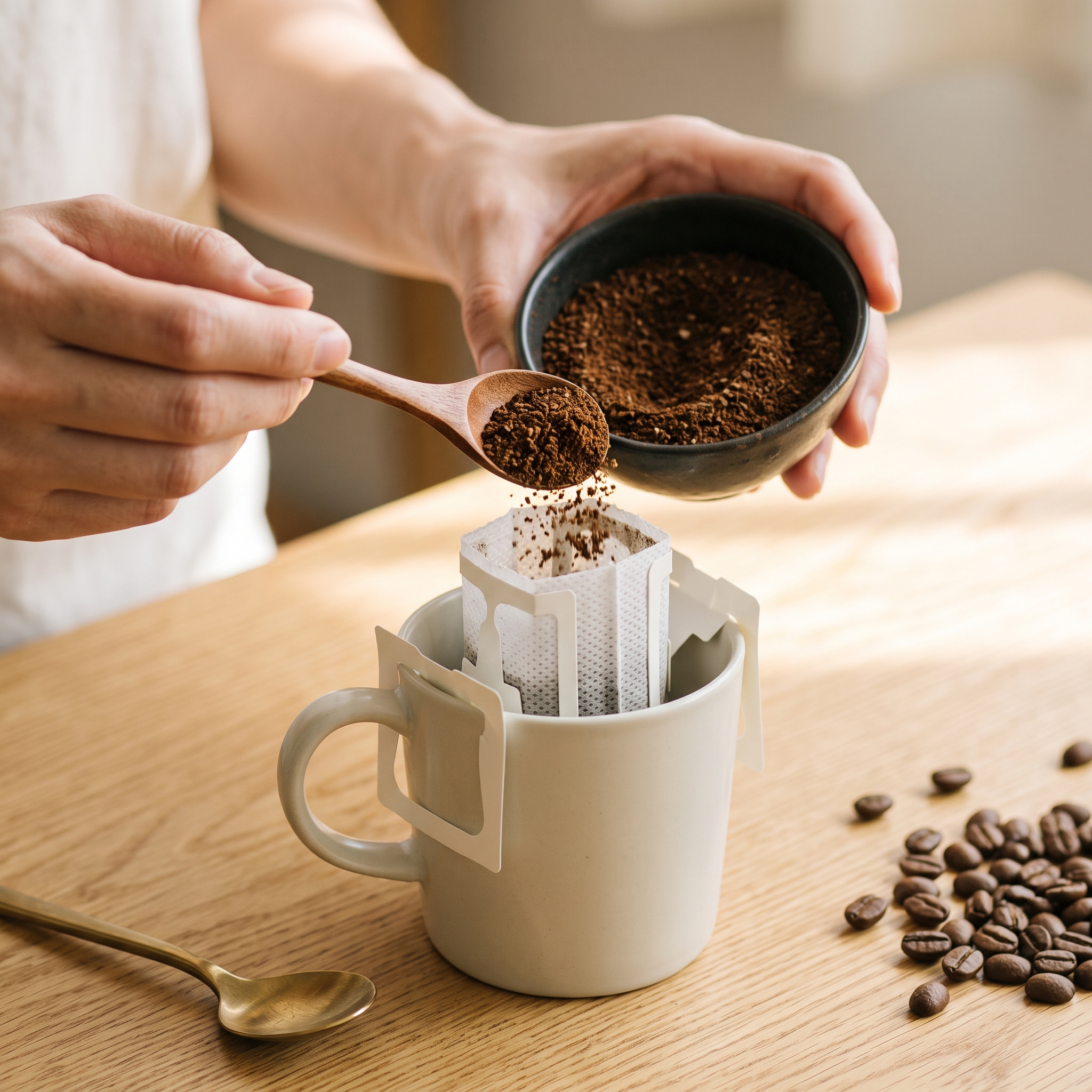
Product Overview: The Anatomy of a Drip Bag System
To understand what makes the “best” coffee grounds for this application, we must first understand the packaging system itself. A commercial drip coffee bag product consists of three vital components:
- The Coffee Payload: Typically between 8 to 12 grams of precisely ground, roasted coffee.
- The Drip Coffee Bag Filter: The inner permeable pouch (usually featuring cardboard “ears” that hang over a mug). This component acts as the brewing vessel and the filtration medium.
- The Outer Barrier Envelope: A sealed, opaque pouch that protects the delicate coffee grounds from their three greatest enemies: oxygen, moisture, and ultraviolet light.
The “best” coffee grounds for this format are those that have been roasted, degassed, and ground specifically to interact perfectly with the flow rate of the chosen filter material, while being preserved flawlessly by the outer envelope. If the grind is too fine, the filter clogs and overflows; if it is too coarse, the water channels through instantly, resulting in a weak, under-extracted beverage.
Materials: The Intersection of Grounds and Packaging
The selection of your packaging materials directly influences how your coffee grounds will perform and how long they will last on the shelf.
Inner Filter Materials (The Brewing Medium)
The material of the drip coffee bag filter dictates the required grind size of your coffee.
- Non-Woven Fabric (PET/PP): This is the industry standard. It offers a consistent, predictable flow rate. Because the pores are highly uniform, it accommodates a standard medium-fine grind exceptionally well. It is cost-effective and heat-sealable, making it ideal for high-speed automated packing lines.
- PLA (Polylactic Acid) Mesh: Made from renewable plant sources (like corn starch), PLA is the premium choice for eco-conscious brands. It is commercially compostable. PLA often has a slightly different flow dynamic than non-woven plastic, sometimes requiring a fractionally coarser grind to prevent clogging, especially with light roasts that generate more “fines” (micro-dust) during grinding. PLA requires ultrasonic sealing technology.
- Paper/Cellulose Blends: While offering a traditional “paper filter” aesthetic, these tend to have slower flow rates. If using paper blends, a slightly coarser grind is mandatory to prevent the brewing process from taking too long and over-extracting bitter compounds.
Outer Envelope Materials (The Preservation Layer)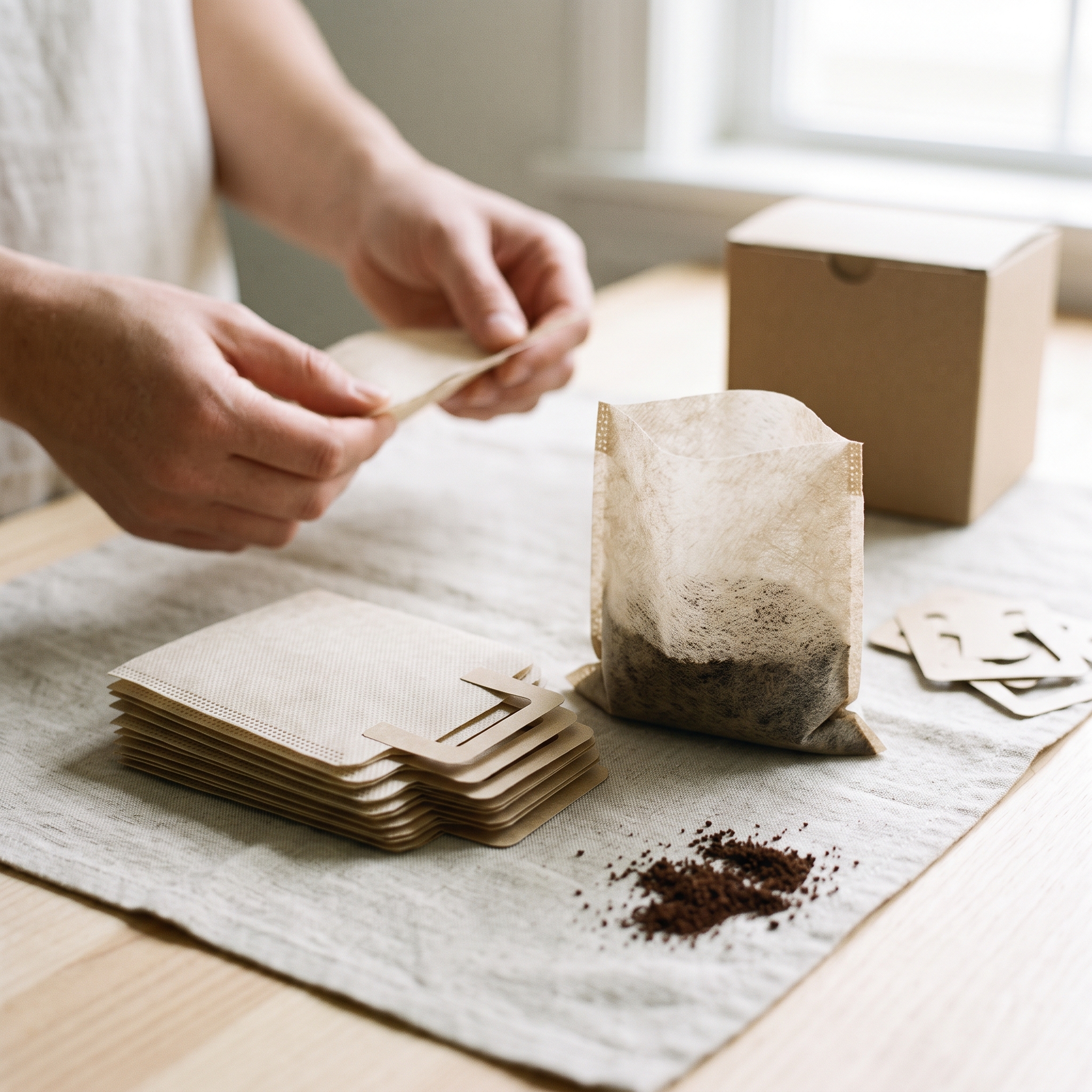
Once coffee is ground, it loses its volatile aromatics exponentially faster than whole beans. The outer packaging must be a fortress.
- PET / VMPET / PE: This three-layer laminate is the workhorse of the industry. The outer PET layer takes high-resolution printing beautifully. The middle VMPET (Vacuum Metalized PET) acts as a rigorous barrier against oxygen and light.
- Kraft / AL / PE: For maximum shelf life, pure Aluminum foil (AL) is used instead of metalized film. Combined with an outer layer of Kraft paper, this gives a highly desirable artisanal, rustic aesthetic while offering an absolute zero-transmission barrier for oxygen.
- Recyclable/Compostable Laminates: Emerging technologies utilize high-barrier EVOH layers combined with mono-materials to create recyclable pouches.
3. Applications
- Specialty Coffee Retail
- Hospitality (Luxury Hotels)
- Corporate & Office Pantries
- Airlines & Railway First-Class
- Outdoor & Camping Industry
4. Key Advantages
- Controlled Extraction
- Nitrogen Flushing Freshness
- Higher Profit Margins
- No Cross-Contamination
Customization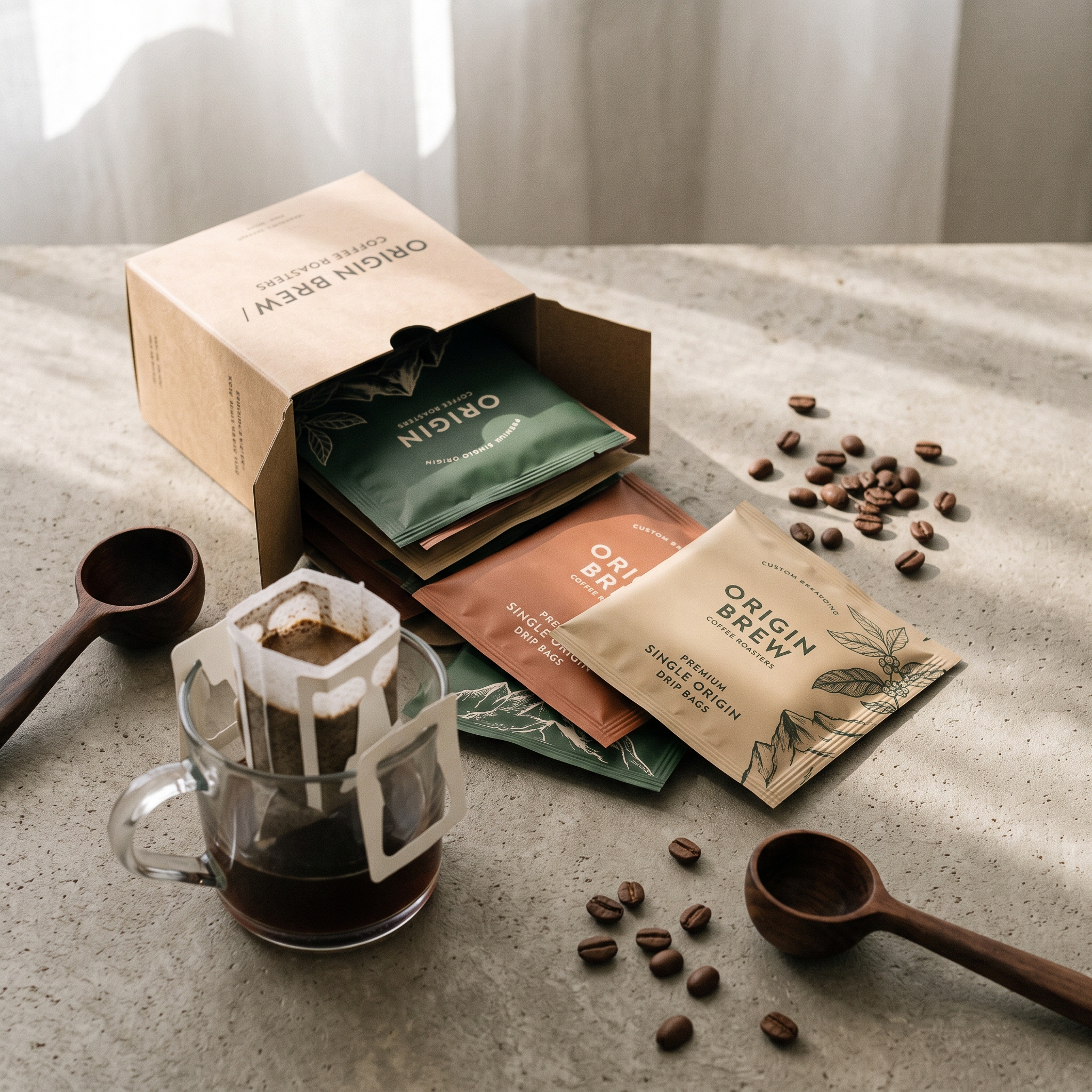
Coffee Parameters
The Roast: Specific testing for brittle dark roasts vs dense light roasts.
Degassing: Critical 48-72 hour protocol to prevent bag “bloating”.
The Dose: Customizable from standard 10g up to 15g.
Packaging Design
Filter Shape: U-Shape standard or Conical V-Shape.
Print Tech: Rotogravure for scale or Digital for multi-SKU.
Finishes: Soft-touch matte, spot-UV, or hot-foil stamping.
6. MOQs & 7. Lead Time
Order Quantities
- Digital Print: 5k – 10k pieces
- Rotogravure: 30k – 50k pieces
- Turnkey Service: 10k+ units
Project Timeline
Total estimated lead time: 6 to 10 weeks from concept to delivery.
Roast Profile vs. Filter Compatibility
| Roast Profile | Bean Density | Grind Size | Ideal Filter | Degassing | Flow Risk |
|---|---|---|---|---|---|
| Light | High | Medium-Fine | PLA Mesh | 5-7 Days | High (Clogging) |
| Medium | Medium | Medium | Non-Woven | 3-5 Days | Low (Standard) |
| Dark | Low | Medium-Coarse | Paper Blend | 2-4 Days | Fast Flow |
10. Frequently Asked Questions (FAQ)
Q: Can I just use the same grind size I use for standard paper filters?
A: Usually, no. To get a proper extraction in the short brew time (approx. 90-120 seconds), you need a slightly finer grind—typically medium-fine, similar to fine table salt.
Q: Why do my finished drip coffee bags look puffed up and swollen?
A: This is a classic packaging failure related to degassing. Trapped CO2 inflates the bag if not properly degassed before sealing.
Q: How does Nitrogen flushing actually work?
A: A nozzle injects food-grade Nitrogen just before sealing, displacing oxygen to below 1% and halting the staling process for 12-18 months.
11. Conclusion
Producing the perfect single-serve pour-over is an exercise in meticulous alignment. By matching your grind size to your filter’s porosity and investing in high-barrier, nitrogen-flushed packaging, you ensure a café-quality experience every time. Mastering this synergy is the key to a highly profitable and loyal product line.
Post time: Sep-20-2026


