The global coffee market has experienced a radical shift over the past few years, with consumer demand moving aggressively toward high-quality, single-serve convenience. By 2026, drip coffee packaging has evolved from a niche Asian market format into a global staple for specialty roasters, hospitality chains, and direct-to-consumer (D2C) brands. Today’s consumers expect the intricate flavor profiles of a V60 pour-over without the requirement of grinders, scales, or gooseneck kettles.
For packaging distributors, wholesale buyers, and roasters, navigating the modern single-serve landscape requires a deep understanding of material science, structural engineering, and shifting regulatory compliance. This comprehensive buyer guide breaks down the defining trends, material innovations, and procurement strategies for drip coffee packaging in 2026.
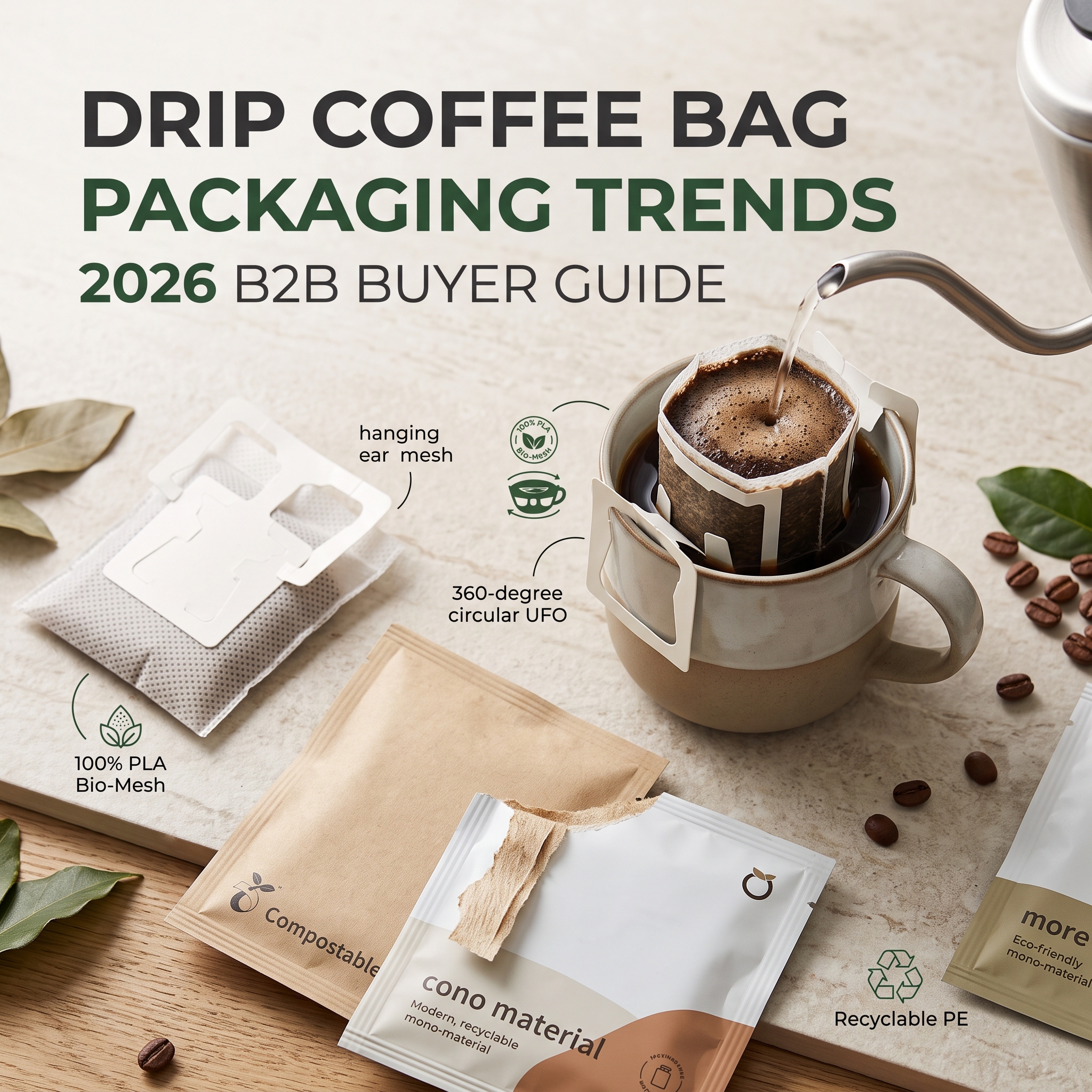
Product Overview
At its core, drip coffee packaging consists of a pre-dosed, micro-porous filter bag (containing 8g to 15g of ground specialty coffee) housed inside a sealed, protective outer barrier sachet. To brew, the user simply opens the sachet, anchors the inner filter to a mug using integrated support arms or rings, and pours hot water over the grounds.
The 2026 Evolution: Beyond the Traditional Hanging Ear
While the traditional rectangular “hanging ear” bag remains a reliable workhorse, 2026 is defined by structural innovation. Advanced designs, such as the circular 360-degree rim support rings (often referred to as UFO or Tonchant filters), have gained significant market share. These advanced formats create a wider, shallower coffee bed that promotes optimal percolation over immersion, mirroring professional barista techniques and eliminating the risk of the filter collapsing into the brewed coffee.
Additionally, the outer sachet has transformed. Gone are the days when multi-layer aluminum foils were the only option. The industry is rapidly pivoting toward high-barrier mono-materials and industrially compostable laminates to meet aggressive global zero-waste mandates.
Materials & Construction Technology
The performance of drip coffee packaging hinges entirely on the materials selected for both the inner filtration web and the outer protective envelope.
A. Inner Filtration Media
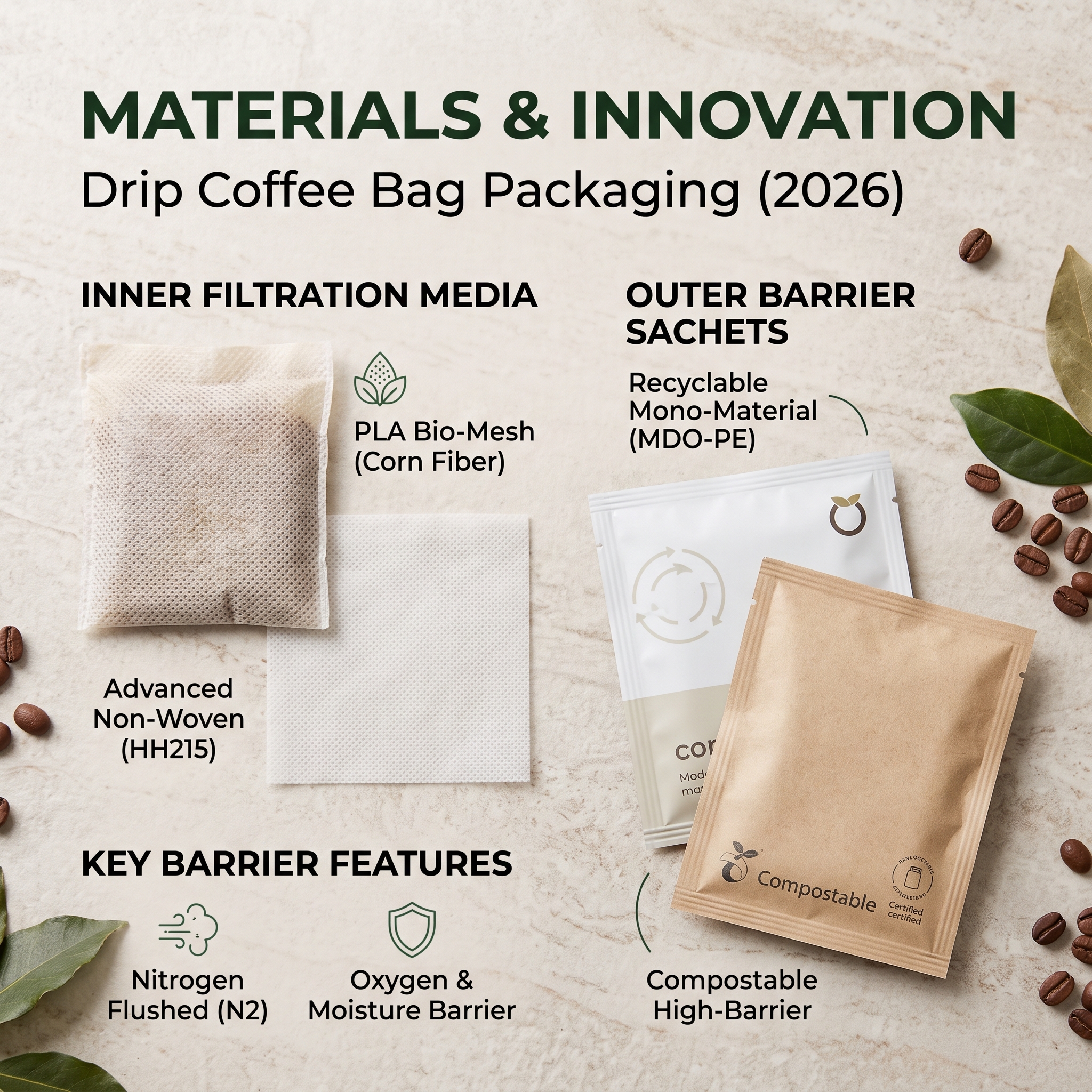
- • PLA (Polylactic Acid) Bio-Mesh: In 2026, PLA is the dominant material for premium brands. Derived from fermented plant starches, 100% bio-based and industrially compostable.
- • Advanced Synthetic Non-Wovens (HH215): Engineered for specialty light roasts, maintaining rapid drip rate and cup clarity.
- • Woven PET Grid: Japanese-engineered ultra-fine mesh for maximum visual transparency.
B. Outer Barrier Sachets
- • Recyclable Mono-Materials: MDO-PE / PE structures that fit standard soft plastic recycling streams.
- • Compostable High-Barrier: Kraft paper and NatureFlex™ cellulose for commercial composting.
- • Traditional Foil (PET/AL/PE): Most cost-effective for maximum shelf life (18+ months).
3. Target Markets
- Specialty Roasters: Low-barrier entry for expensive microlots.
- Luxury Hospitality: Replacing pods for elevated guest experiences.
- Airlines & Cruise Lines: Fresh pour-over at 30,000 feet.
- Corporate Gifting: High-impact branded merchandise.
- D2C E-Commerce: Perfect for lightweight subscription boxes.
4. Key Advantages
- Nitrogen Flushing: Preserves freshness for 12-18 months.
- No Equipment: Just hot water and a mug required.
- Superior Taste: Authentic freshly ground coffee beans.
- Eco-Friendly: Lower carbon footprint than rigid pods.
5. Customization & Branding Capabilities
Printing Technologies
HP Indigo Digital: No plates, ideal for seasonal releases and small batches.
Rotogravure: Gold standard for high-volume, exact Pantone matching.
Value-Added Finishes
Tactile Coatings: Soft-touch matte, spot UV, and metallic foil stamping.
Laser Scoring: Custom tear notches for effortless opening.
Filter Printing: Food-safe branding on the inner support arms.
6. MOQ (Minimum Order Quantity)
- Blank Stock: 1,000 – 5,000 units
- Digital Custom: 5,000 – 10,000 units
- Rotogravure: 50,000+ units
- OEM Full Turnkey: 10,000 – 20,000 units
7. Production Lead Times
- Generic Materials: 3 – 5 business days
- Digitally Printed: 10 – 14 business days
- Rotogravure (First Run): 3 – 4 weeks
- Full OEM Delivery: 4 – 6 weeks
8. Quality Control, Safety & Certificates
Because the inner filter web comes into direct contact with near-boiling water (90°C – 96°C), rigorous food safety compliance is the most critical aspect of procurement.
9. FAQ for B2B Buyers
Q1: How do I choose between standard rectangular hanging ears and 360-degree circular filters?
Standard rectangular bags are highly cost-effective and familiar. Circular filters (UFO style) offer superior percolation and hold larger doses (up to 15g), ideal for premium specialty roasts.
Q2: What is the optimal grind size for drip coffee packaging?
A medium-fine grind (similar to table salt) is ideal. Too fine will clog the micro-pores; too coarse will result in weak extraction.
Q3: Can my local commercial roastery pack these bags automatically?
Yes, but specialized equipment with ultrasonic sealers and nitrogen flushing is required. Many brands use turnkey co-packing partners to avoid heavy machinery investment.
Q4: Is the outer aluminum foil sachet recyclable?
Traditional PET/AL/PE laminates are not. For sustainability, specify MDO-PE mono-material structures.
Q5: Does PLA bio-mesh affect the flavor of the coffee?
No. Certified PLA corn fiber is completely flavor-neutral, odorless, and non-reactive.
10. 2026 Material Comparison Table
| Feature / Metric | Traditional Foil & PP Web | 2026 Recyclable Mono-Material | 2026 Fully Compostable System |
|---|---|---|---|
| Inner Filter Material | Non-Woven PP/PET | PLA Bio-Mesh or HH215 | PLA Bio-Mesh (Corn Fiber) |
| Outer Sachet Material | PET / AL / PE | MDO-PE / EVOH / PE | Kraft / NatureFlex™ / Bio-PE |
| Barrier Performance | Ultra-High (18+ Months) | High (12-14 Months) | Moderate (9-12 Months) |
| End-of-Life Disposal | Landfill | Store Drop-Off Recycling | Industrial Compost Facility |
| Target Brand Persona | Mass Market / Wholesale | Modern Retail / Eco-Conscious | Zero-Waste / Organic Specialty |
| Unit Cost | $ (Lowest) | $$ (Medium) | $$$ (Premium) |
By carefully selecting the right structural formats, sustainable material substrates, and agile printing methods, B2B buyers can future-proof their supply chains and deliver cafe-quality experiences directly into the hands of consumers worldwide. Whether outfitting a luxury hotel chain or launching a boutique D2C subscription, modern drip coffee formats are the definitive packaging solution for the next era of specialty coffee.
Post time: Sep-07-2026


