A Comprehensive Technical Analysis of Sustainable Tea Packaging Materials, Compliance Standards, and Strategic Procurement Considerations
The global beverage packaging sector is undergoing a structural transition driven by stringent single-use plastic regulations, extended producer responsibility (EPR) mandates, and heightened consumer awareness. For decades, conventional tea bags relied on non-woven filtration meshes reinforced with petroleum-based synthetic polymers—predominantly polypropylene (PP), polyethylene terephthalate (PET), and nylon (polyamide). While these synthetic resins provide seal integrity and dimensional stability during high-speed packing and boiling-water immersion, they introduce a persistent environmental problem: microplastic shedding into the beverage and non-biodegradable waste in landfills.
For packaging distributors, restaurant chains, food service buyers, and private-label importers, transitioning to a truly biodegradable tea bag format is no longer merely a brand differentiator—it is a critical compliance and risk-mitigation strategy.
This guide delivers an in-depth technical analysis of sustainable tea bag materials, manufacturing pathways, barrier characteristics, extraction mechanics, global compostability standards, and strategic procurement considerations.
What Is a Biodegradable Tea Bag?
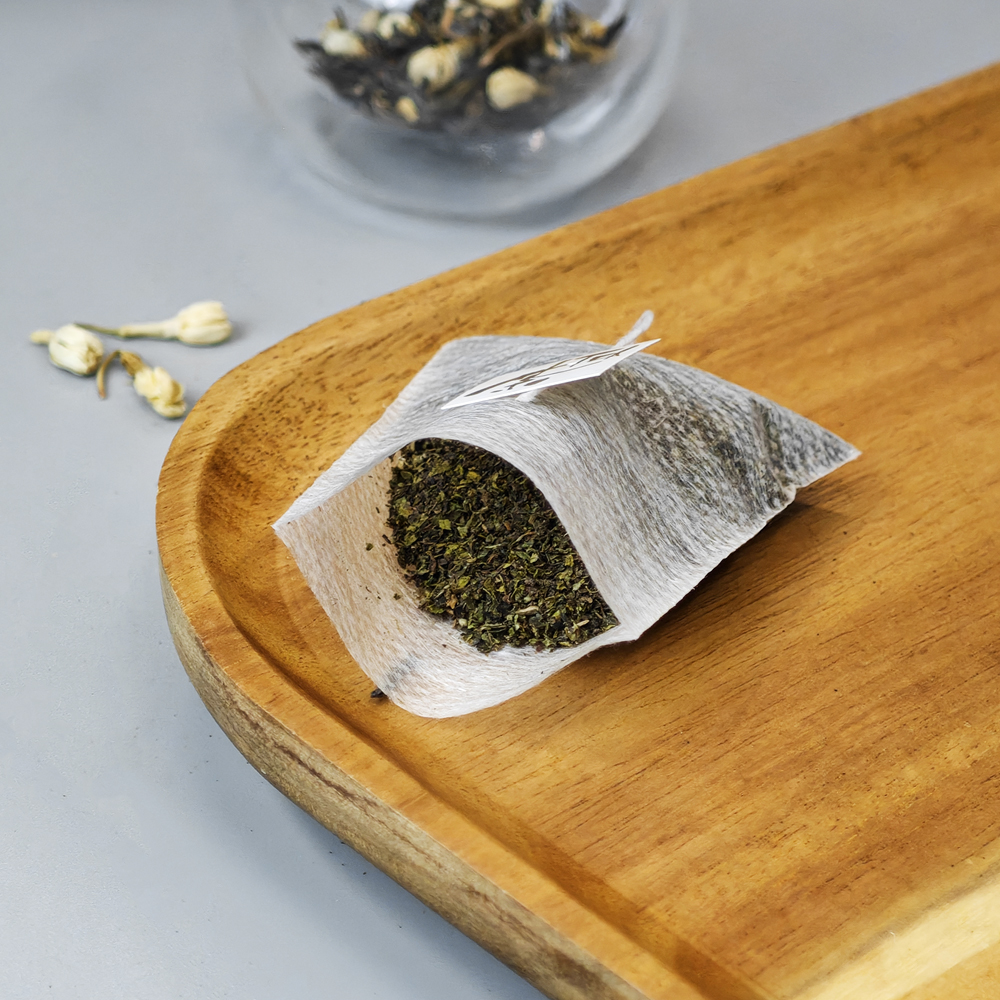
In the tea and herbal infusion industry, the term “biodegradable” often suffers from ambiguous marketing. Technically, a biodegradable tea bag is an infusion sachet constructed from bio-based polymers, unbleached plant fibers, or composite bio-materials that undergo biological breakdown by naturally occurring microorganisms (bacteria, fungi, and algae) into carbon dioxide, water, and biomass, leaving no synthetic toxic residues or persistent microplastics behind.
From a material science perspective, biodegradable tea packaging encompasses three primary substrate families:
1. Polylactic Acid (PLA) Woven and Non-Woven Mesh: Derived from fermented plant starches (principally non-GMO corn, cassava, or sugarcane). In the industry, PLA woven mesh is frequently referred to as “corn fiber mesh” or “bioplastic netting.” It delivers high optical clarity, excellent tensile modulus, and precise aperture control, making it the benchmark substrate for pyramid (tetrahedral) tea bags.
2. Cellulose and Abacá Non-Woven Filter Papers: Formulated from renewable natural wood pulps combined with long plant fibers from abacá (Musa textilis, commonly known as Manila hemp). When engineered without petroleum-derived thermoplastic resins, these papers are naturally home-compostable and biodegradable.
3. Cellulose-Derived Transparent Films and Webs: Regenerated cellulose derived from agricultural residues or FSC-certified wood pulp, engineered for customized permeability and infusion kinetics.
A complete biodegradable sachet system includes not just the filter membrane, but also the thread and the tag:
- · The Filter Web: Constituting 70–85% of the package mass.
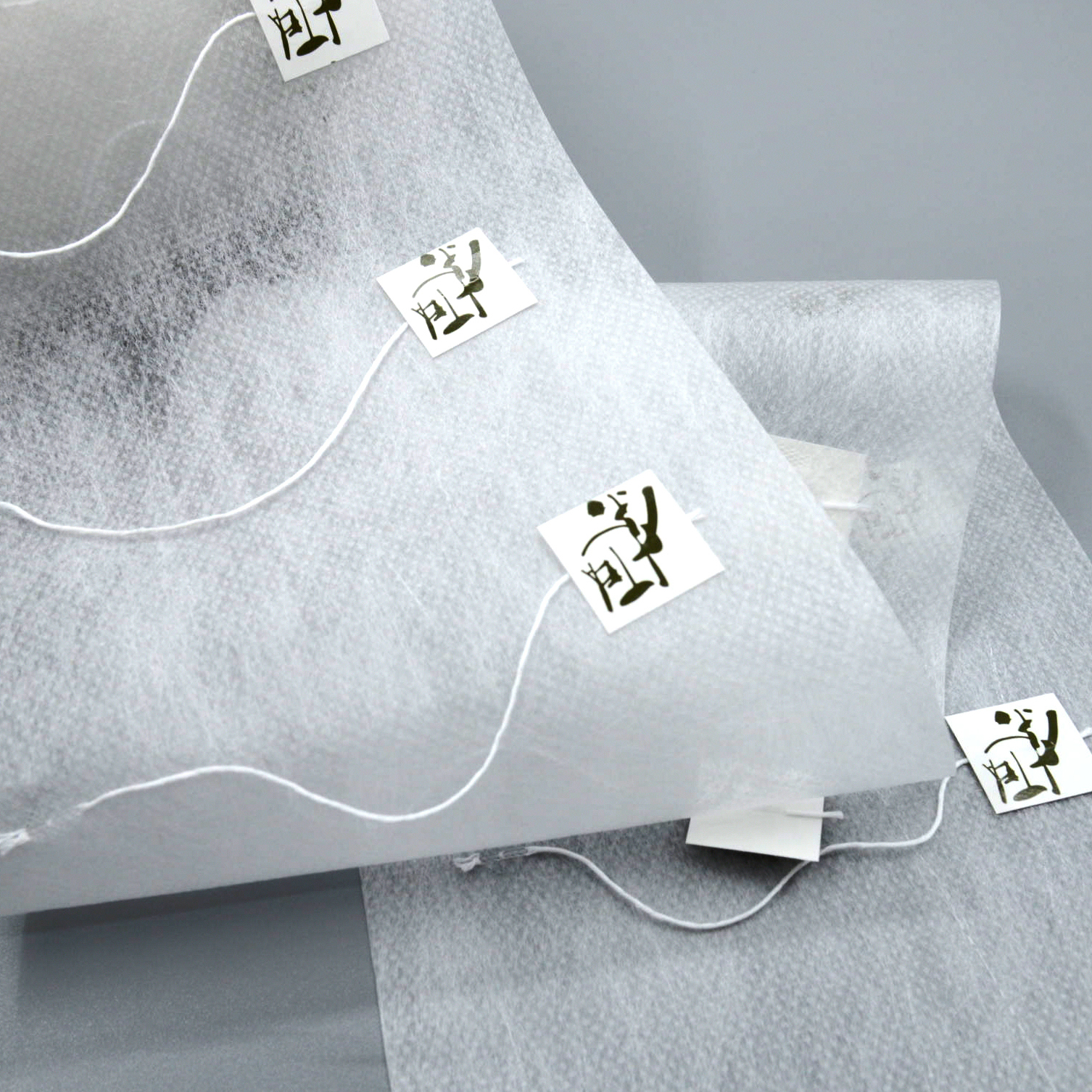
- · The Drawstring: Pure unbleached organic cotton or continuous filament PLA yarn.
- · The Tag: Uncoated or aqueous-coated paperboard, printed exclusively with water-based or soy-based food-grade inks, free from plastic laminates.
- · Sealing Mechanism: Ultrasonic weld bonding or pure mechanical folding, fully eliminating petroleum hot-melt adhesives.
How Are Biodegradable Tea Bags Produced?
The production pipeline for sustainable tea packaging transforms raw agricultural or forestry biomass into an ultra-thin, hydrothermally stable, food-safe porous web through tightly controlled physical and chemical conversion processes.
Production Pipeline Overview:
Agricultural Starch / Abacá Pulp → Polymerization / Pulp Refining → Extrusion / Wet-Laid Web Formation → Micro-Perforation / Mesh Weaving → Ultrasonic Converting & Form-Fill-Seal (FFS)
1. Raw Material Sourcing and Monomer Synthesis
- · For PLA Filter Mesh: Corn, cassava, or sugar beet starches undergo enzymatic hydrolysis to extract glucose. The glucose is fermented using bacterial strains (e.g., Lactobacillus) to generate lactic acid. The lactic acid is chemically dimerized into lactide monomers through catalytic dehydration, followed by ring-opening polymerization (ROP) under high vacuum and controlled heat to yield high-molecular-weight polylactic acid resin.
- · For Abacá Filter Paper: Stems of the abacá plant are mechanically stripped, washed, and chemically pulped through mild alkaline digestion. This separates the high-tensile lignocellulose fibers (average fiber length 4.5–6.0 mm) without damaging their intrinsic crystalline orientation.
- · PLA Non-Woven / Woven Netting: The dried PLA pellets are extruded through a high-precision multi-hole spinneret at melt temperatures between 210°C and 230°C. For woven pyramid mesh, monofilament yarns (typically 20–30 denier) are drawn, oriented to maximize tensile strength, and woven on water-jet or air-jet looms into uniform square meshes (apertures ranging from 100 to 180 microns). For non-wovens, spunbond or meltblown technologies lay down continuous filament webs that are thermally bonded via calender rollers.
- · Wet-Laid Paper Formation: Abacá and wood cellulose fibers are suspended in an aqueous slurry at very low consistency (0.05–0.15% solids). The suspension is cast onto an inclined wire former, hydro-entangled, and vacuum-dewatered. To establish wet-burst strength without petroleum polymers, food-grade bi-component fibers or wet-strength polyamide-epichlorohydrin resins complying with FDA 21 CFR § 176.170 are strictly metered under precise pH conditions.
2. Filament Extrusion and Web Formation
3. Surface Finishing and Calendering
The porous webs pass through heated calender rolls to calibrate thickness, air permeability, and basis weight (typically 12 to 24 g/m²). No fluorescent whitening agents (FWAs) or elemental chlorine bleaches are introduced during finishing to prevent toxic dioxin formation.
4. High-Speed Converting (Form-Fill-Seal Packaging)
On automated packing lines (such as Fuso, Maisa, IMA, or Tsubakimoto machines), the master rolls are slit into target slit widths (e.g., 120 mm, 140 mm, 160 mm). During converting:
- · Continuous webs are shaped into pouches or pyramids.
- · Ultrasonic welding horns generate high-frequency acoustic vibrations (20–40 kHz), creating localized friction that melts PLA chains together at the molecular level, forming hermetic seals in under 0.2 seconds.
- · For paper substrates lacking thermoplastic binders, mechanical crimping, stitching, or bio-hot-melt ultrasonic embossing is utilized.
Key Properties and Characteristics
Procurement managers must balance structural reliability on industrial packaging lines against performance inside the consumer’s teacup.
1. Thermal and Hydrolytic Resistance
- · Glass Transition Temperature (Tg): Unmodified PLA has a Tg of approximately 55°C–60°C. When exposed to boiling water (95°C–100°C), ordinary PLA can soften or undergo dimensional distortion. To resolve this, high-performance PLA tea filter meshes utilize stereocomplex or highly crystalline PLA grades with melting points (Tm) exceeding 165°C–175°C, ensuring zero bag shrinkage or seam collapse during standard 3-to-5-minute hot brews.
- · Wet Tensile Strength: A standard biodegradable tea bag filter paper must maintain a longitudinal wet tensile strength of at least 0.25–0.45 kN/m to avoid tearing under mechanical agitation from spoons or consumer pulling.
- · Flow Dynamics: Pore volume and aperture distribution dictate extraction efficiency. The open matrix of woven PLA mesh (120–160 µm opening) allows unobstructed water exchange and rapid solubilization of polyphenols, catechins, and theaflavins.
- · Dust Particle Retention: For Broken Orange Pekoe (BOP) or fine tea fannings/dust, micro-aperture wet-laid non-wovens (apertures of 20–50 µm) are required to prevent sediment settling at the bottom of the cup, while retaining adequate water-permeability (typically 1,500 to 4,500 L/m²/s at 100 Pa pressure drop).
2. Porosity, Aperture Size, and Liquor Infusion Kinetics
3. Sensory Neutrality and Organoleptic Integrity
Because bio-based packaging components are subjected to sustained heat during extraction, volatile organic compound (VOC) generation must be zero. PLA and virgin unbleached abacá fibers exhibit zero aroma migration, preserving the volatile terpenes and delicate sensory notes of premium single-origin white, green, and oolong teas.
Advantages of Biodegradable Tea Bags
1. Mitigation of Microplastic and Nanoplastic Contamination
Peer-reviewed chemical studies (notably by Tufenkji et al., McGill University) highlighted that steeping a single plastic tea bag (nylon or PET) at 95°C can release billions of microplastic and nanoplastic particles into a single serving. Certified bio-based materials—such as high-purity PLA mesh or 100% natural abacá paper—eliminate synthetic polymer ingestion risks, addressing a significant concern for health-conscious consumers.
2. Corporate Compliance with Extended Producer Responsibility (EPR)
Packaging waste directives across the European Union (e.g., EU Packaging and Packaging Waste Regulation – PPWR), the UK, and several US states (California SB 54, Washington, New York) are imposing punitive tax levies and recycling fees on non-recyclable multi-material packaging. Transitioning to certified industrially or home-compostable tea sachets exempts brands from non-recyclable plastic penalties and aligns commercial inventories with regulatory trajectories.
3. Premium Merchandising and Optical Value
Woven PLA mesh provides clarity and structural integrity comparable to traditional nylon mesh. It allows consumers to view whole-leaf tea grades, dried botanicals, dehydrated fruits, and spices inside the pyramid sachet. This visual transparency justifies higher price points in retail, hospitality, and specialty gift markets.
4. Direct Diversion to Organic Waste Streams
Because used tea leaves constitute clean, nitrogen-rich organic waste, separating a conventional plastic tea bag from its interior biomass is labor-prohibitive for municipal composting facilities. Fully compostable tea bags can be discarded directly into municipal green bins or commercial compost operations alongside the wet spent leaves, closing the biological nutrient loop.
Limitations and Technical Challenges
A balanced technical assessment must evaluate the operational constraints of biodegradable polymers relative to traditional petroleum-based polymers.
1. Specific Degradation Conditions for PLA
While PLA is certified biodegradable, it is predominantly industrially compostable. It requires:
- · Maintained thermophilic temperatures (>58°C).
- · Relative humidity above 60–90%.
- · An active population of thermophilic hydrolytic microorganisms.
In typical home compost bins, sea water, or dry landfill environments, ambient temperatures rarely reach the glass transition threshold required for rapid hydrolysis. Consequently, an untreated PLA tea bag may persist for years in a standard home compost pile. For brands pursuing home-compostability claims, abacá-wood pulp composite papers without synthetic resins must be selected over woven PLA.
2. Thermal Window and Converting Sensitivity
PLA has a narrower thermal processing window than PP or nylon. Excessive ultrasonic energy can burn the polymer and generate embrittled edges, while insufficient acoustic energy results in weak seal seams that rupture when boiling water is poured over the bag. Converting machinery must feature precise digital frequency tuning and dynamic anvil cooling.
3. Supply Chain Price Premiums
On average, high-purity PLA woven mesh commands a 30% to 55% raw material cost premium over standard polypropylene and polyethylene terephthalate (PET) meshes. Furthermore, wet-laid unbleached abacá paper is subject to agricultural yield cycles, resulting in price volatility compared to petroleum-derived synthetic substrates.
4. Shelf Life and Hygroscopic Sensitivity
Biopolymers are inherently sensitive to moisture, heat, and ultraviolet radiation. Master rolls of PLA mesh or natural cellulose paper must be warehoused within climatically controlled environments (temperatures between 15°C and 25°C, relative humidity <50%) to prevent premature brittleness, warping, or tensile decay during long-term storage.
Common Applications Across Market Segments
Application Segments Overview:
The biodegradable tea bag market spans three primary application segments: Specialty Retail (Pyramid Sachets with High-clarity PLA), Commercial Food Service & Hospitality (Abacá Filter Paper), and Herbal & Medicinal Blends (High-density Web).
1. Specialty Tea Brands (Pyramid/Tetrahedral Sachets): Utilizing woven PLA mesh (140 mm to 160 mm widths) for whole-leaf Darjeeling, Longjing, rolled oolongs, and tisanes. The three-dimensional pyramid architecture provides 50% more volumetric space than flat square bags, allowing tea leaves to expand and yield full extraction.
2. Commercial Food Service and Chain Restaurants: High-speed converted rectangular single-chamber or double-chamber abacá-blend paper bags with cotton string and tag. Preferred for operational efficiency, rapid infusion speed, and seamless integration into high-volume breakfast buffets and airline catering.
3. Medicinal and Ayurvedic Herbal Infusions: Dense botanicals, coarse roots (such as ginger, licorice, and ashwagandha), and finely crushed medicinal herbs require high-grammage (18–21 g/m²) unbleached wet-laid paper to minimize particulate dusting while withstanding prolonged decoction boiling without paper structural failure.
4. Cold Brew Tea and Coffee Pouches: Large-format biodegradable filtration pouches (50 g to 200 g dry fill capacity) manufactured from reinforced non-woven PLA webs designed for extended water submersion (12 to 24 hours) without fiber degradation.
Material Comparison: Biodegradable vs. Traditional Substrates
To assist procurement teams in evaluating mechanical and operational trade-offs, the following matrix compares the predominant tea filtration substrates used across global manufacturing facilities:
| Technical Parameters | PLA Woven Mesh (Corn/Cane) | Abacá / Natural Wood Pulp Paper | Traditional Polypropylene (PP) Filter Paper | Nylon (PA6 / PA66) Woven Mesh |
| Primary Feedstock | Renewable plant starches (fermented) | Natural plant lignocellulose | Crude oil derivative | Synthetic petrochemical |
| Visual Appearance | Semi-transparent / Silky sheen | Opaque natural / Matt tan or white | Opaque, semi-fibrous | High transparency / Glossy sheen |
| Aperture Range | 100 – 180 µm | 20 – 60 µm | 15 – 50 µm | 100 – 200 µm |
| Typical Basis Weight | 18 – 27 g/m² | 12 – 21 g/m² | 16 – 24 g/m² | 18 – 26 g/m² |
| Wet Tensile Strength | High (>0.65 kN/m) | Moderate (0.25–0.45 kN/m) | High (>0.55 kN/m) | Superior (>0.90 kN/m) |
| Sealing Compatibility | Ultrasonic welding | Ultrasonic / Bi-polymer or Crimp | Heat-sealable (180–220°C) | Ultrasonic welding |
| Extraction Rate | Fast / Unobstructed | Moderate to rapid | Controlled / Moderate | Fast / Unobstructed |
| Microplastic Leaching | None (Zero petroleum polymers) | None | High (Polypropylene shedding) | Critical (Polyamide fragments) |
| End-of-Life Profile | Industrial compost (EN 13432) | Home & industrial compostable | Non-biodegradable (Landfill) | Non-biodegradable (Landfill) |
| Relative Material Cost | High | Low to Moderate | Low (Industry baseline) | Moderate to High |
What Buyers Should Consider When Sourcing
Procurement managers, distributors, and private-label brand owners must conduct systematic technical due diligence before entering into long-term commercial supply agreements.
1. Global Compostability Certifications
Never rely on unverified supplier claims of “eco-friendly” or “100% natural.” Demand third-party lab documentation from recognized conformity bodies:
- · Industrial Compostability: Verification under EN 13432 (Europe), ASTM D6400 (North America), or ISO 17088. Look for the Seedling logo (TÜV AUSTRIA / DIN CERTCO) or BPI (Biodegradable Products Institute) certifications.
- · Home Compostability: TÜV AUSTRIA OK compost HOME certification or AS 5810 (Australia), ensuring complete biological breakdown within 12 months at ambient temperatures (20°C–30°C).
- · Non-Toxicity & Heavy Metals: Compliance with EN 13432 limits on heavy metals (zinc, copper, nickel, lead, cadmium, mercury, arsenic).
2. Food-Contact Safety Approvals
Because extraction occurs in near-boiling water, chemical migration testing is critical:
- · FDA Compliance: Adherence to FDA 21 CFR § 177.1630 and relevant dietary polymer extractive regulations under high-temperature conditions.
- · EU Food Safety Regulations: Conformance with EU Regulation No 10/2011 on plastic materials intended to come into contact with food, including Overall Migration Limit (OML) and Specific Migration Limits (SML) tests using food simulants (water, 3% acetic acid, 10% ethanol at 100°C for 2 hours).
3. Machine Processability and Equipment Downtime
Transitioning to biodegradable rolls can disrupt packaging operations if roll geometry is poorly matched to your machinery. Key mechanical specifications to audit:
- · Elongation at Break: Must not stretch excessively under mechanical drive-roll tension.
- · Static Charge Control: PLA can build up electrostatic charges in low-humidity converting rooms. Ensure the material incorporates food-grade antistatic treatments or install ionizing bars on your converting line.
- · Core Tolerances and Slit Consistency: Inconsistent roll tension or slit-edge fraying results in web wandering, mistracking, and machine stops. Working with specialized converters like Sokoo Group ensures precision roll winding, tight edge tolerances, and customized core dimensions engineered specifically for high-speed automated packaging machinery.
4. Raw Material Traceability and Feedstock Integrity
Verify whether the bio-based carbon content is validated via carbon-14 radio-dating pursuant to ASTM D6866. For wood and abacá paper options, demand FSC (Forest Stewardship Council) or PEFC (Programme for the Endorsement of Forest Certification) chain-of-custody documentation to guarantee zero connection to deforestation. If sourcing PLA, confirm whether the product utilizes non-GMO corn starch to meet strict organic brand specifications in key target export markets.
Frequently Asked Questions (FAQ)
1. Can biodegradable tea bags break down in a standard backyard home compost?
It depends entirely on the base material. Abacá-wood pulp filter papers without plastic binders are fully home-compostable and generally degrade in a backyard pile within 6 to 12 weeks. Conversely, woven PLA (corn fiber) tea bags require thermophilic conditions (>58°C) to activate hydrolysis and will not reliably degrade in a cold home compost bin. PLA tea bags should be sorted into municipal commercial organic collection bins certified for industrial composting.
2. Do biodegradable tea bags release microplastics into boiling water?
No. High-quality biodegradable tea bags constructed from 100% plant-cellulose or certified PLA contain zero petroleum-derived polymers like polypropylene, nylon, or polyethylene. Even if sub-micron organic particles are shed during infusion, they are bio-based monomers (such as lactic acid or cellulose fragments) that do not possess the toxicological persistence or bio-accumulation characteristics associated with fossil fuel microplastics.
3. Are heat-sealable biodegradable tea bags truly plastic-free?
Standard “heat-sealable” filter papers historically required an internal blend of 20% to 30% polypropylene or polyethylene fibers to melt and form the seal. Today, fully biodegradable alternatives use an ultra-thin dispersion of PLA biopolymers, bio-based heat-seal coatings, or rely on mechanical folding, stitching, and ultrasonic bonding. Buyers must confirm that any heat-sealable paper explicitly specifies PLA or an aqueous bio-sealant rather than conventional synthetic polyolefins.
4. Does ultrasonic sealing work on all biodegradable materials?
Ultrasonic sealing requires a material with thermoplastic properties. It works reliably on woven and non-woven PLA meshes because the polymer melts locally when acoustic friction is introduced. Pure abacá and cellulose papers do not melt under ultrasonic agitation and must be processed using mechanical crimping, stitching, or with a certified biodegradable heat-sealable binder web.
5. How long is the shelf life of unused biodegradable tea bag rolls?
When stored in their original barrier packaging inside dry, temperature-controlled warehouses (15°C–25°C, relative humidity below 50%), certified PLA and natural abacá rolls have a typical shelf life of 18 to 24 months. Prolonged exposure to ambient humidity, UV light, or high temperatures will initiate premature structural degradation and web embrittlement.
6. Why is woven PLA mesh more expensive than standard filter paper?
Woven PLA mesh involves a multi-tier manufacturing process: enzymatic starch conversion, industrial fermentation, monomer purification, polymer polymerization, monofilament fiber spinning, precision weaving, and post-annealing. The extensive chemical and textile conversion infrastructure, combined with smaller global production volumes compared to commodity polypropylene, accounts for the higher price point.
7. What printing inks are safe for biodegradable tea tags?
Tea tags attached to biodegradable sachets must be printed with certified food-grade, heavy-metal-free, water-based or vegetable-based (soy) inks. Solvent-based mineral oil inks are prohibited because they can migrate through the secondary paper packaging, disrupt compostability, and introduce aromatic hydrocarbons (MOSH/MOAH) into the beverage.
Strategic Sourcing Outlook
The tea and botanical infusion industry is moving away from single-use petroleum filtration media. Regulatory mandates such as the European Union’s packaging overhauls, state-level plastic bans in North America, and consumer preference for clean, microplastic-free extraction make eco-friendly packaging materials essential for sustained market share.
Successfully executing a material transition requires balancing extraction clarity and web tensile strength against strict compostability compliance and high-speed packaging efficiency. Enterprise buyers, distributors, and private-label manufacturers should partner with knowledgeable manufacturing partners like Sokoo Group to secure certified, reliable material rolls tailored to precise machine configurations and international food-contact standards.
Investing in verified, fully traceable biodegradable tea packaging reduces regulatory exposure, enhances brand equity, and delivers an uncompromised, clean beverage experience directly to the consumer’s cup.
### About This Guide
This technical guide is intended for packaging distributors, procurement directors, private-label brand managers, food service buyers, and contract packaging engineers evaluating biodegradable tea bag substrates. All technical specifications, certification references, and regulatory citations reflect current international standards as of the date of publication. For product quotations, custom specifications, or sample requests, please contact the packaging materials sales team.
Post time: Sep-15-2026


